
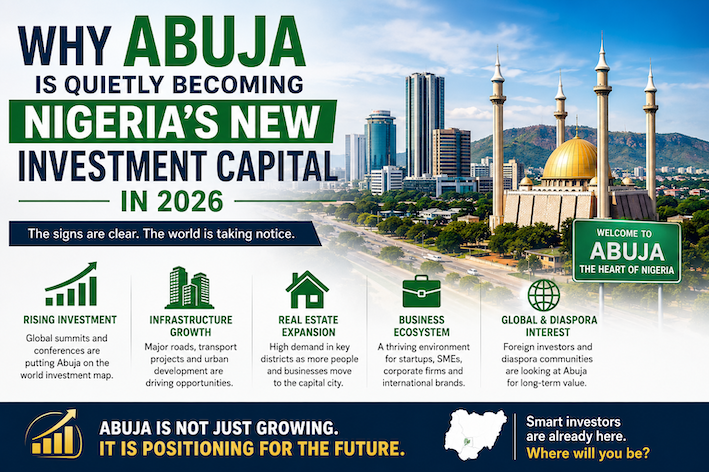
For years, Lagos dominated Nigeria’s investment narrative.
But something significant is happening quietly in 2026:
Abuja is increasingly positioning itself as Nigeria’s emerging investment and economic command center.
From global investment summits and infrastructure expansion to rising real estate demand and growing institutional presence, the capital city is attracting a different kind of attention — the attention of investors, policymakers, and long-term business builders.
A New Wave of Investment Attention
Abuja is witnessing a surge in investment conferences, economic summits, infrastructure-focused discussions, and institutional business activity.
One of the clearest examples is the growing momentum around major investment events positioning Abuja as a global deal-making environment for sectors such as infrastructure, energy, technology, agriculture, finance, and healthcare.
Why Investors Are Looking at Abuja Differently
Unlike Lagos, Abuja offers a more structured environment for long-term investment.
- Planned city layout
- Expanding infrastructure
- Government and diplomatic presence
- Growing high-income population
Abuja’s role as Nigeria’s administrative and institutional center continues to attract both local and international stakeholders.
Infrastructure Is Accelerating Growth
Infrastructure expansion is becoming one of Abuja’s strongest investment drivers.
Projects linked to road expansion, transportation, commercial development, and urban growth are reshaping business opportunities across the capital region.
This is one reason investors are paying closer attention to districts such as Jahi, Guzape, Lugbe, Lokogoma, and Kuje.
Abuja’s Business Ecosystem Is Expanding
The city is no longer driven only by government activity.
Today, Abuja is seeing rapid growth in real estate, hospitality, retail, financial services, technology, and lifestyle businesses.
Foreign and Diaspora Interest Is Increasing
Diaspora and foreign investment interest in Nigeria is also shifting toward structured opportunities.
Abuja’s image as a more organized and stable urban market makes it increasingly attractive for long-term investors, diaspora buyers, and international partnerships.
The Rise of Abuja’s Premium Economy
Another major signal is the rise of Abuja’s premium consumer economy.
Across the city, cafés, luxury apartments, premium retail, wellness brands, and hospitality concepts are expanding rapidly.
Consumers are spending more on experience, quality, convenience, and trusted brands.
Abuja vs Lagos: The Strategic Difference
Lagos still dominates in commercial scale and transaction volume.
But Abuja offers lower entry costs in key sectors, more organized urban planning, stronger institutional concentration, and increasing long-term growth potential.
Many smart investors are now using a dual strategy: cash flow in Lagos and asset positioning in Abuja.
Why Timing Matters
One of Abuja’s biggest advantages today is timing.
The city is still expanding, which means more room for growth, less saturation, and stronger upside potential in emerging sectors.
This is especially important for real estate investors, retail operators, hospitality brands, and infrastructure-focused businesses.
Final Thoughts
Abuja is no longer just Nigeria’s political capital.
It is increasingly becoming a strategic investment capital.
From infrastructure and real estate to business expansion and institutional growth, the signals are becoming clearer in 2026.
For smart investors and entrepreneurs, Abuja is not just growing. It is positioning itself for the future.
Related Reads
- Top Real Estate Investment Zones in Abuja
- Where Smart Investors Are Putting Money in Abuja
- Abuja vs Lagos: Where Should You Invest?
Want Visibility for Your Business or Investment?
Connect with customers, investors, and opportunities across Abuja.
Leave a Reply
You must be logged in to post a comment.