
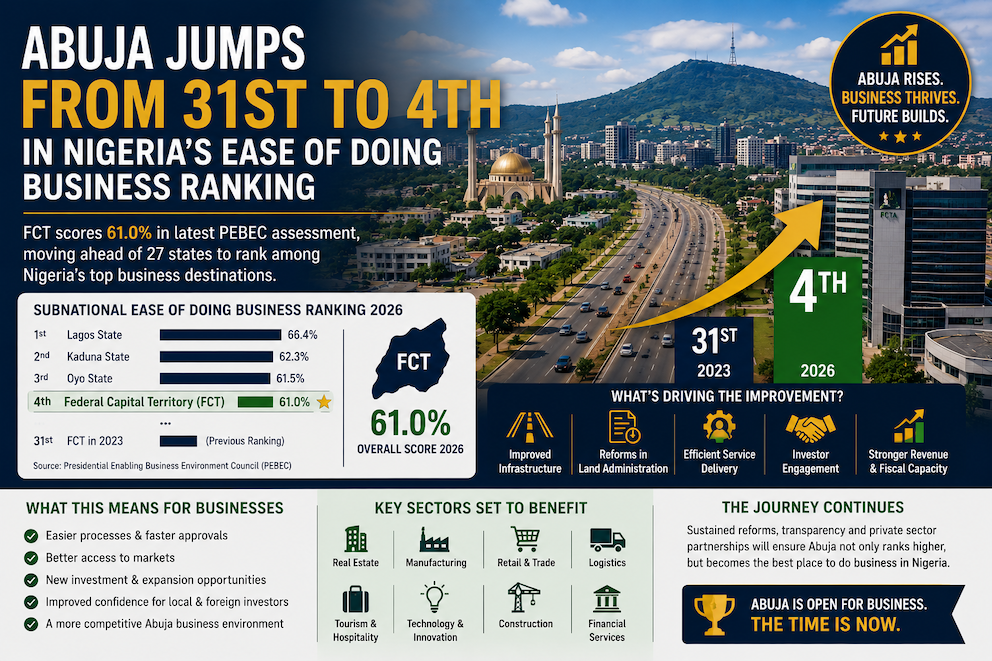
Abuja has recorded one of the most dramatic improvements in Nigeria’s latest subnational business-environment assessment.
The Federal Capital Territory has moved from 31st position in the 2023 Subnational Ease of Doing Business assessment to fourth place in the latest ranking, with a reported score of 61.0 per cent.
Only Lagos, Kaduna and Oyo ranked ahead of the FCT.
For Abuja, the improvement is significant.
But rankings alone do not make a city easier to do business in.
The more important question for entrepreneurs and investors is:
What has actually changed — and can businesses feel the difference?
From 31st to Fourth
Abuja’s rise represents a substantial turnaround from its position in the 2023 assessment.
The latest Subnational Ease of Doing Business assessment by the Presidential Enabling Business Environment Council places the FCT fourth nationally.
The improvement has been linked to reforms across infrastructure, land administration, service delivery and investment promotion.
Business significance: A better business-environment ranking can strengthen investor confidence, but the real economic value comes when reforms reduce the actual time, uncertainty and cost involved in operating a business.
Infrastructure Is Changing Abuja’s Commercial Map
Infrastructure renewal is one of the most visible changes taking place across Abuja.
Road construction and rehabilitation are improving access across existing districts while opening previously difficult locations to residential and commercial development.
Better infrastructure can affect businesses through:
- Reduced travel time
- Improved customer access
- Lower logistics friction
- New commercial corridors
- Higher property demand
- Improved investor confidence
For businesses choosing where to locate new stores, offices, warehouses or developments, infrastructure increasingly determines where future demand could emerge.
Land Administration Is Becoming a Business Issue
Land is one of Abuja’s most valuable economic assets.
It has also historically been one of the most complicated areas for investors and developers.
Efforts to improve land administration therefore have consequences far beyond real estate.
Faster and more transparent land processes can influence:
- Property development
- Mortgage financing
- Industrial investment
- Commercial construction
- Foreign investment
- Infrastructure partnerships
At the same time, the FCT Administration has made clear that it intends to take a harder position against land speculation, fraudulent development and projects that violate the Abuja Master Plan.
That creates an important distinction for investors.
Abuja may be becoming more open to investment, but credible development and regulatory compliance are likely to become increasingly important.
Abuja Is Actively Competing for Private Capital
Another significant change is the intensity with which Abuja is now positioning itself to investors.
The Abuja Business and Investment Expo 3.0 brought together government officials, financial institutions, diplomatic missions, private companies and development organisations in August.
The FCT Administration used the gathering to reinforce the message that Abuja is open to credible local and international investors.
Abuja Investments Company Limited has also been pushing for investment conversations to move beyond conferences into projects, partnerships and actual capital deployment.
Insight: Abuja is increasingly treating investment attraction as an economic-development function rather than simply a promotional exercise.
Private-Sector Investment Is Becoming More Important
Abuja cannot finance its next stage of development through government budgets alone.
The scale of infrastructure, housing, transport, industrial and commercial development required means private capital will have to play a larger role.
Opportunities could increasingly emerge through:
- Public-private partnerships
- Infrastructure concessions
- Property development
- Industrial investment
- Capital-market financing
- Institutional investment
The SEC has already encouraged the FCT Administration to make greater use of Nigeria’s capital market for long-term infrastructure financing.
What Does ‘Ease of Doing Business’ Actually Mean?
For an entrepreneur, ease of doing business is not an abstract ranking.
It is experienced through everyday interactions.
Businesses care about questions such as:
- How difficult is it to secure approvals?
- How predictable are government processes?
- How quickly can land documentation be completed?
- How reliable is infrastructure?
- How many agencies must a business deal with?
- How transparent are fees and taxes?
- How easy is it to resolve disputes?
These are the areas where Abuja’s improved ranking will ultimately be tested.
Why the Ranking Matters for Foreign Investors
International investors compare markets.
They evaluate not only potential returns but also the difficulty of entering and operating within a jurisdiction.
A stronger business-environment ranking can therefore help Abuja compete for:
- Corporate expansions
- International hotel investment
- Technology companies
- Industrial projects
- Retail brands
- Infrastructure capital
- Professional-services firms
Abuja also benefits from proximity to federal institutions, regulators, diplomatic missions and development-finance organisations.
If administrative processes continue improving, that institutional concentration could become a stronger commercial advantage.
What It Means for Small Businesses
The real test of business reform is not whether large investors can navigate the system.
It is whether ordinary businesses can operate more efficiently.
For Abuja’s SMEs, improvements should eventually translate into:
- Faster approvals
- Clearer processes
- Better infrastructure
- More predictable fees
- Improved access to government services
- Greater access to business-support programmes
If these improvements are not experienced at street level, the ranking will have limited practical meaning.
Abuja Still Has Major Business Constraints
Fourth place does not mean Abuja’s business environment is problem-free.
Businesses still face significant challenges, including:
- High energy costs
- Expensive commercial property
- Financing constraints
- Transport and logistics costs
- Regulatory complexity
- Macroeconomic uncertainty
Recent increases in fuel costs, for example, place additional pressure on smaller businesses through transportation, distribution and self-generation expenses.
Ease-of-doing-business reform therefore has to continue alongside broader improvements in the economic environment.
Can Abuja Challenge Lagos?
Lagos remains Nigeria’s dominant commercial centre.
Abuja does not need to replicate Lagos to become a stronger business destination.
Its competitive advantages are different.
Abuja combines:
- Federal government proximity
- Diplomatic presence
- Planned urban development
- A growing premium consumer market
- Institutional investment activity
- Large infrastructure programmes
The opportunity is to turn those advantages into a distinctive business environment rather than simply competing with Lagos on scale.
What Abuja Must Do Next
Moving from 31st to fourth is impressive.
Staying there — or moving higher — will be harder.
The next stage should focus on measurable outcomes:
- Shorter approval times
- More transparent land administration
- Digital government services
- Better infrastructure reliability
- Reduced regulatory friction
- Stronger support for SMEs
- More private investment
Businesses should be able to measure the improvement themselves.
Final Thoughts
Abuja’s rise from 31st to fourth in Nigeria’s subnational ease-of-doing-business ranking is an important signal.
It suggests that changes in infrastructure, administration and investment policy are beginning to register beyond political announcements.
But rankings are only the beginning.
The real objective is a capital city where entrepreneurs can start businesses more easily, investors can deploy capital with greater confidence and existing companies can expand without unnecessary friction.
If Abuja can translate its improved ranking into those everyday outcomes, the city’s business transformation will become much more consequential than moving up a league table.
Related Reads
- Why Abuja Is Quietly Becoming Nigeria’s New Investment Capital in 2026 “`
- Best Business Opportunities in Abuja Right Now
- Where Smart Investors Are Putting Money in Abuja
- Explore Abuja Business Directory “`
Want to Position Your Business in Abuja?
Abuja Business News provides visibility for businesses, investors and professional firms participating in the capital’s expanding economy.