
Abuja is experiencing one of its most visible periods of infrastructure development in years.
Roads are being constructed and rehabilitated, abandoned projects are returning to life, new districts are opening up and infrastructure investment is increasingly shaping property and business activity across the Federal Capital Territory.
But behind the construction boom is a financial question that businesses, investors and residents cannot ignore.
How should Abuja pay for its transformation?
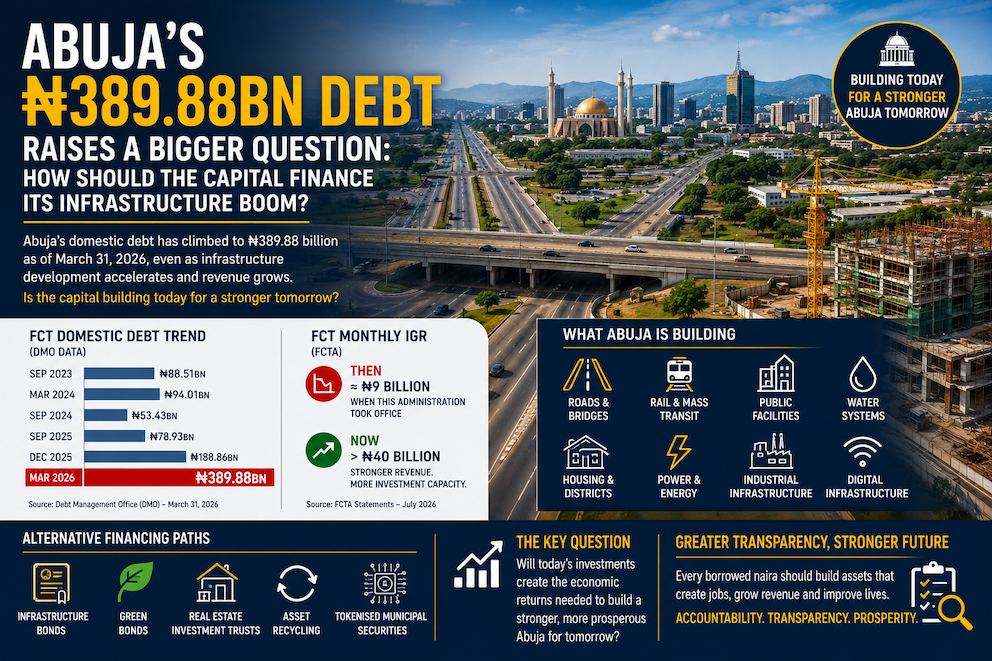
Data from the Debt Management Office show that the Federal Capital Territory’s domestic debt stood at approximately ₦389.88 billion as of March 31, 2026.
That represents a significant increase from ₦88.51 billion in September 2023 and has pushed the FCT into the upper ranks of Nigeria’s most indebted sub-national governments.
The figures are now generating a wider debate about infrastructure, borrowing, internally generated revenue and the long-term financing model for Nigeria’s capital.
How Abuja’s Domestic Debt Reached ₦389.88 Billion
According to DMO figures reported in August, the FCT’s domestic debt moved through several stages between 2023 and 2026.
- September 2023: ₦88.51 billion
- March 2024: ₦94.01 billion
- September 2024: ₦53.43 billion
- September 2025: ₦78.93 billion
- December 2025: ₦188.86 billion
- March 2026: ₦389.88 billion
The most significant increase occurred between December 2025 and March 2026, when the debt stock rose by roughly ₦201 billion.
The scale of that increase has inevitably attracted scrutiny.
Business significance: Borrowing is not inherently good or bad. The critical question is whether borrowed capital creates productive assets capable of generating sufficient economic and fiscal returns over time.
Infrastructure Is the Other Side of the Story
Abuja’s debt numbers cannot be examined in isolation from the physical transformation occurring across the FCT.
The administration has pursued an aggressive infrastructure programme covering roads, transport corridors, public facilities and previously abandoned projects.
Better infrastructure can create economic value by:
- Reducing travel time
- Opening new development corridors
- Increasing property values
- Improving logistics
- Attracting private investment
- Expanding commercial districts
- Increasing taxable economic activity
That means the correct measure of Abuja’s infrastructure programme cannot simply be the amount spent.
The more important measure is what the infrastructure ultimately produces.
FCT Revenue Has Also Increased Sharply
The administration argues that Abuja’s financial capacity has improved substantially.
FCT Minister Nyesom Wike said in July that monthly internally generated revenue had increased from approximately ₦9 billion when the current administration took office to more than ₦40 billion.
The administration attributes the increase to stronger revenue collection, reduced leakages and increased collection of land-related revenues including ground rents and Certificates of Occupancy.
If sustained, stronger IGR gives Abuja significantly greater capacity to finance infrastructure and service debt.
But it also raises an important benchmark.
Businesses and investors should be able to see whether increased revenue is translating into infrastructure and public services that further expand the city’s economic base.
The TSA Decision Changed Abuja’s Financing Model
The FCT Administration has also linked its infrastructure programme to its exit from the Treasury Single Account framework.
According to the administration, the change gave the FCT greater flexibility to use its internally generated revenue in arranging commercial financing for infrastructure projects.
That represents a major shift in how the capital funds development.
Instead of waiting for annual budget allocations to accumulate before undertaking major projects, infrastructure can potentially be financed against future revenue.
This can accelerate development.
It can also increase financial risk if borrowing grows faster than the revenue and economic productivity needed to support it.
The ₦389.88bn Question Is Really About Returns
For investors, the most useful way to assess public borrowing is to examine what the borrowed money creates.
Debt used for recurrent consumption has a fundamentally different economic profile from debt used to build productive infrastructure.
Infrastructure borrowing becomes easier to justify when projects:
- Unlock commercially valuable land
- Increase business activity
- Generate additional tax revenue
- Reduce transportation costs
- Attract private capital
- Create jobs
- Improve productivity
The long-term question is therefore whether Abuja’s current infrastructure programme will generate economic returns proportionate to its financing costs.
Could Abuja Use the Capital Market Instead?
Nigeria’s Securities and Exchange Commission has suggested that Abuja should broaden the way it finances infrastructure.
Speaking at the Abuja Business and Investment Summit and Expo in August, SEC Director-General Emomotimi Agama argued that cities cannot be built by annual budgets alone.
He identified several capital-market instruments that could potentially finance Abuja’s development.
These include:
- Infrastructure bonds
- Green bonds
- Real Estate Investment Trusts
- Asset recycling
- Tokenised municipal securities
These mechanisms could potentially connect Abuja’s infrastructure requirements with pension funds, institutional investors and other pools of long-term capital.
Infrastructure Bonds Could Change the Model
Infrastructure bonds could allow the FCT to raise money specifically for defined projects rather than relying entirely on conventional borrowing.
A properly structured bond could finance projects such as:
- Major roads
- Rail infrastructure
- Water systems
- Mass transit
- Industrial infrastructure
- Urban regeneration
For investors, the advantage is greater transparency around what capital is being raised for and how repayment will be structured.
Green Bonds Could Finance Abuja’s Next Generation of Infrastructure
Abuja’s rapid expansion also creates an opportunity to think beyond conventional infrastructure.
Green bonds could potentially support projects involving:
- Renewable energy
- Energy-efficient public buildings
- Clean transportation
- Waste management
- Water infrastructure
- Climate-resilient urban development
This could give Abuja access to investors specifically seeking sustainable infrastructure assets.
REITs Could Bring Private Capital Into Property Development
Abuja has one of Nigeria’s most valuable property markets.
Real Estate Investment Trusts could provide a mechanism for institutional and retail investors to participate in income-producing property without every investor purchasing buildings directly.
Potential areas include:
- Commercial property
- Residential rental portfolios
- Industrial property
- Student accommodation
- Hospitality assets
Properly structured, this could deepen Abuja’s property investment market while reducing pressure on government to finance every development itself.
Asset Recycling Could Unlock Existing Public Assets
Abuja already owns valuable infrastructure and commercial assets.
Asset recycling allows government to concession, lease or monetise mature assets and reinvest the proceeds into new infrastructure.
Instead of continually borrowing against future revenue, existing assets can therefore become part of the financing solution.
Private Capital Must Become More Important
Abuja’s infrastructure requirements are too large to be financed indefinitely through government revenue and conventional debt alone.
A sustainable long-term model will require more private-sector participation.
That could include:
- Public-private partnerships
- Infrastructure concessions
- Institutional investment
- Development finance
- Private real estate development
- Capital-market financing
The government’s role then begins shifting from being the sole financier toward creating commercially credible projects that private capital is willing to fund.
Transparency Will Matter More as Financing Becomes Sophisticated
More sophisticated financing requires stronger disclosure.
Investors need clear information about:
- Total debt obligations
- Interest costs
- Project expenditure
- Repayment schedules
- Revenue assumptions
- Project completion
- Economic returns
Greater transparency would make it easier to distinguish productive infrastructure financing from unsustainable borrowing.
What Abuja Businesses Should Watch
The financing debate matters directly to businesses.
Infrastructure determines where commercial activity can expand.
Businesses should watch:
- Which road corridors receive new investment
- Expansion of rail and mass transit
- Industrial infrastructure projects
- New housing developments
- Commercial land opened by infrastructure
- New PPP opportunities
- FCT bond or capital-market programmes
These decisions can influence property prices, customer movement, logistics costs and where future commercial districts emerge.
Final Thoughts
Abuja’s ₦389.88 billion domestic debt deserves scrutiny.
But the bigger economic question is not simply whether Abuja is borrowing.
It is whether the capital is building assets capable of generating more economic value than the cost of financing them.
Abuja needs roads, rail, housing, water, industrial infrastructure and modern transportation.
The challenge is finding a financing model that allows the city to build quickly without creating an unsustainable burden for the future.
Infrastructure bonds, green finance, REITs, asset recycling and private capital could become increasingly important parts of that answer.
Abuja’s infrastructure boom may be visible in concrete and asphalt.
Its long-term success will ultimately be measured on the balance sheet — and in the economic activity those investments create.
Related Reads
- Why Abuja Is Quietly Becoming Nigeria’s New Investment Capital in 2026 “`
- Where Smart Investors Are Putting Money in Abuja
- Top Real Estate Investment Zones in Abuja Right Now
- Explore Abuja Business Directory “`
Want to Position Your Business in Abuja?
Abuja Business News provides visibility for businesses, investors and professional firms participating in the capital’s expanding economy.