
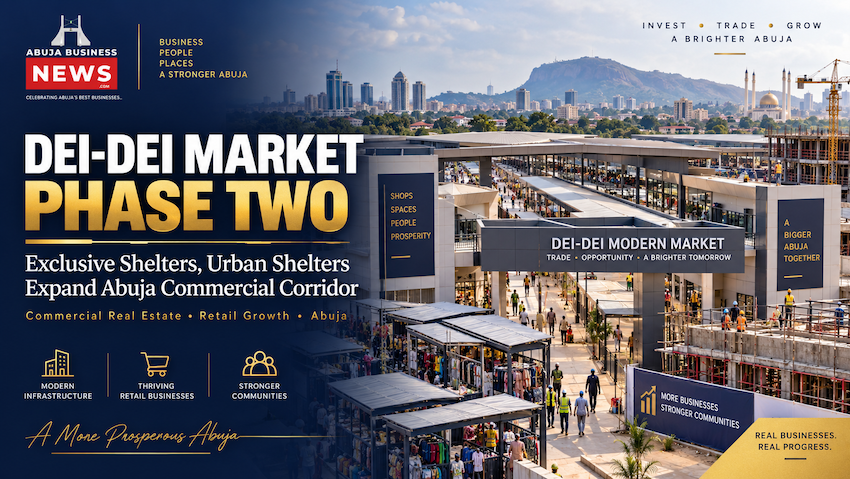
Abuja’s Dei-Dei commercial corridor is entering another phase of development as Exclusive Shelters partners with Urban Shelters Infrastructure Limited to develop Phase Two of the Dei-Dei Ultra-Modern Market.
The expansion is aimed at increasing commercial real-estate capacity in one of the Federal Capital Territory’s established trading and building-material corridors while creating additional space for retailers, traders, entrepreneurs and other businesses.
The partnership brings together Exclusive Shelters, a private real-estate development company, and Urban Shelters Infrastructure Limited for the next stage of the market development.
Phase Two expands Abuja’s commercial real-estate pipeline
The launch reflects continued private-sector interest in commercial property outside Abuja’s traditional premium districts.
Dei-Dei has long operated as an important commercial destination, particularly for building materials, construction-related businesses, wholesale activity and businesses serving Abuja’s expanding residential communities.
Expanding the market introduces additional organised commercial space into an area that already supports a substantial base of traders, suppliers, artisans, distributors and property investors.
Developers point to demand from the first phase
Exclusive Shelters and Urban Shelters said the decision to proceed with Phase Two follows demand generated by the first phase of the project.
The developers have described Phase One as having attracted significant investor interest and said the next phase is intended partly to accommodate prospective investors and businesses that were unable to participate in the initial development.
Those statements represent the developers’ assessment of the project. Detailed financial information on the first phase, including independently verified investment returns, has not been publicly released.
Urban Shelters enters strategic partnership
Urban Shelters Infrastructure Limited’s participation adds an established real-estate and infrastructure operator to the project.
Rilwan Salihu Aliyu, Managing Director of Urban Shelters Infrastructure Limited, described the agreement as the beginning of a longer-term strategic relationship between the two organisations.
Exclusive Shelters Managing Director Ahmad Bello Kawuwa has similarly positioned the partnership as a significant milestone in the company’s commercial real-estate development strategy.
Why Dei-Dei matters to Abuja’s business economy
Abuja’s commercial property market is not limited to office towers, shopping malls and high-value neighbourhood retail.
Large organised markets remain an important part of the city’s economic infrastructure because they provide operating space for thousands of small and medium-sized businesses across wholesale, retail, distribution, manufacturing support and professional services.
Commercial-market developments can also stimulate demand for logistics, banking, payments, warehousing, transport, food services, security, insurance and other supporting businesses.
Infrastructure is changing the investment case
The developers have linked the market’s expansion to wider infrastructure improvements around the Dei-Dei and Karsana growth corridor.
Improved road connectivity between Dei-Dei, Life Camp and other parts of Abuja can materially affect the commercial attractiveness of the area by reducing travel time, improving accessibility and expanding the population that can reach businesses operating there.
This relationship between public infrastructure and private real-estate investment is becoming increasingly visible across the FCT.
New roads frequently change the economics of previously less-accessible areas, increasing land values and creating new opportunities for retail, housing, warehousing, hospitality and commercial development.
A different kind of Abuja property opportunity
Much of Abuja’s property conversation focuses on residential estates in districts such as Maitama, Asokoro, Guzape, Katampe, Wuse and Jabi.
Commercial-market developments such as Dei-Dei operate under a different investment model.
Their value is tied more closely to business activity, trader occupancy, customer traffic, accessibility and the strength of the surrounding commercial ecosystem.
That can make organised market developments relevant to investors seeking exposure to income-generating commercial property rather than purely residential appreciation.
Opportunities for Abuja SMEs
For small and medium-sized businesses, additional formal commercial space can reduce some of the limitations associated with informal operating environments.
Depending on the final configuration of Phase Two, opportunities could emerge for businesses involved in:
- building materials and construction supplies;
- home improvement and interior products;
- wholesale and distribution;
- logistics and delivery;
- financial and payment services;
- food and convenience retail;
- professional and technical services; and
- property and facility management.
Important details are still outstanding
While the partnership and Phase Two launch have been confirmed, several commercial details have not yet been publicly disclosed.
These include the total project value, number and mix of units, construction timetable, investment thresholds, payment structures and expected completion date.
Prospective investors should therefore evaluate the actual project documentation and contractual terms rather than relying solely on promotional statements about future returns.
Abuja’s commercial geography continues to broaden
The larger signal is that Abuja’s commercial-development map continues to expand beyond the city centre.
Districts and corridors connected by major infrastructure are increasingly attracting organised retail, housing, warehousing and mixed commercial development.
Dei-Dei’s location, existing commercial activity and improving connectivity make it one of the areas worth watching as Abuja’s population and business footprint continue to expand.
What businesses and investors should watch next
The next indicators will be the scale and specification of Phase Two, construction progress, occupancy demand and the types of businesses that ultimately take space in the expanded market.
It will also be important to see whether the development attracts more institutional interest into organised commercial-market infrastructure across other emerging Abuja districts.
If demand remains strong, projects such as the Dei-Dei Ultra-Modern Market could become an increasingly important component of Abuja’s commercial real-estate sector—linking property development directly to the growth of traders, SMEs and distribution businesses.