
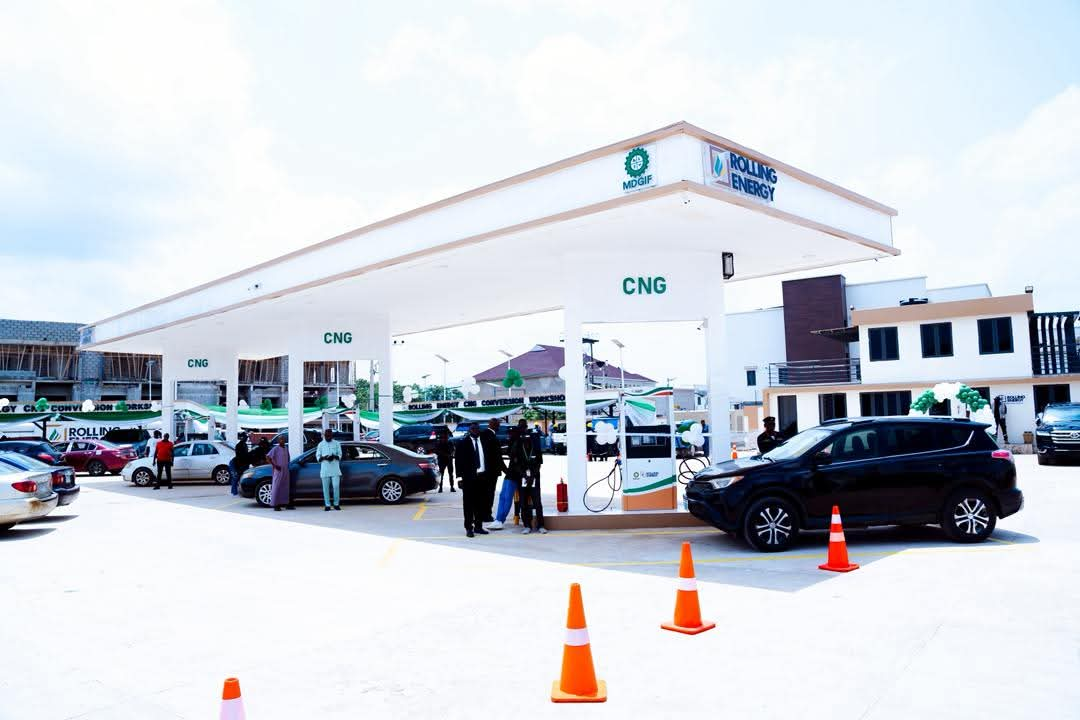
Rolling Energy has opened an integrated CNG refuelling and vehicle-conversion station in Karu with capacity to serve about 150 vehicles and convert roughly 12 vehicles a day, adding alternative-fuel infrastructure on Abuja’s eastern corridor.
The facility, commissioned on 6 November along Saint George Akume Way, combines compressor and dispenser systems in one unit. It also includes a two-pit conversion centre, making it both a fuel-access point and a workshop for motorists and fleet operators moving from petrol to compressed natural gas.
What opened in Karu
The station was developed through a partnership involving the State House, the Presidential Initiative on Compressed Natural Gas and Electric Vehicles (Pi-CNG & EV) and Rolling Energy Limited. State House Permanent Secretary Temitope Fashedemi said an abandoned petrol facility was provided for the project, while Rolling Energy funded its rehabilitation and installed the CNG equipment without direct government expenditure on the works.
Rolling Energy chief executive Mubarak Danbatta said the station has double-nozzle dispensers that allow vehicles to refuel from both sides. Its daily throughput of about 150 vehicles will depend on cylinder sizes and available pressure, while the conversion centre’s two service pits can process about 12 vehicles a day.
The operator offered free CNG refuelling to motorists in nearby communities for more than a week during testing, according to NAN. Commercial users should verify the station’s current pump price, service hours and conversion charges now that the facility has moved beyond testing.
Why the location matters for Abuja business
Karu sits on a heavily travelled eastern approach to Abuja, linking residential districts and commuter flows with central business areas. A functioning refuelling and conversion point in this corridor can reduce the distance CNG users travel to find fuel and may improve fleet utilisation for transport companies, dispatch operators and businesses that run regular vehicle routes.
The commercial value will depend less on the launch ceremony than on reliable daily operation: steady gas supply, safe dispensing, predictable queue times and enough conversion capacity to turn interest into usable vehicles. At 12 conversions a day, the workshop could complete about 300 conversions in a 25-day operating month if demand, kits and technicians are consistently available. That is a simple capacity illustration, not a forecast of actual output.
For Rolling Energy, Karu also expands an operating footprint that already includes Abuja and other locations. Danbatta said the company was working toward nearly 15 refuelling and conversion facilities by the end of 2026, with two additional stations expected in Kano and two in Kaduna. Delivery against that target would strengthen its position in a market where station density remains a constraint on vehicle adoption.
Private capital is driving the network
Pi-CNG executive chairman Ismaeel Ahmed said at the commissioning that the national network had about 106 operational refuelling stations, with another 170 at different stages of development or regulatory approval. Nairametrics, which attended the event, also reported that Pi-CNG linked the programme to about $2.6 billion in private-sector investment.
The figures should be read with care. Pi-CNG’s own website displayed 105 refuelling stations when checked on 10 November, one fewer than the event statement. That may reflect a publishing lag or a difference in the cut-off used for the Karu commissioning, but Abuja Business News is retaining the distinction rather than presenting the totals as identical.
The wider investment case is clear: government can contribute policy support, licensing coordination and—in this project—an underused site, while a private operator carries rehabilitation, equipment and operating risk. The test for investors is whether station utilisation and fuel margins can support that capital after the initial incentives and publicity fade.
Practical implications for fleet operators
- Confirm compatibility before committing: use an accredited conversion centre and obtain written confirmation that the kit, cylinder and installation suit the vehicle model and duty cycle.
- Model the full payback: compare conversion cost, CNG pump price, petrol displacement, expected mileage, downtime and maintenance—not fuel price alone.
- Check operating reliability: verify current opening hours, queue patterns, pressure availability and alternative stations before assigning CNG vehicles to time-sensitive routes.
- Keep safety records: retain installation certificates, cylinder-inspection information and maintenance history, and ensure drivers understand shut-off and emergency procedures.
- Pilot before scaling: businesses with larger fleets can convert a small number of vehicles first and compare real cost per kilometre with equivalent petrol vehicles.
What investors and customers should watch
The useful operating indicators will be daily refuelling volumes, equipment uptime, realised conversion output, pump pricing and repeat use by commercial fleets. Regulatory progress on the 170 stations described as being developed or licensed will also show whether the national network is growing quickly enough to support vehicle conversions outside a few established corridors.
For Abuja, the Karu station adds both fuel access and workshop capacity on a corridor used by commuters and commercial fleets. Its real impact will be measured by whether users can refuel safely, consistently and at a cost that produces a credible operating saving.
Related Reads
- Shafa Energy Launches Shafa CNG to Drive Nigeria’s Clean Energy Future
- FCTA Reviews $1.5bn Abuja E-Mobility and Green Investment Proposal
- GIGM Opens Gwagwalada Terminal in Abuja Network Expansion
Leave a Reply
You must be logged in to post a comment.