
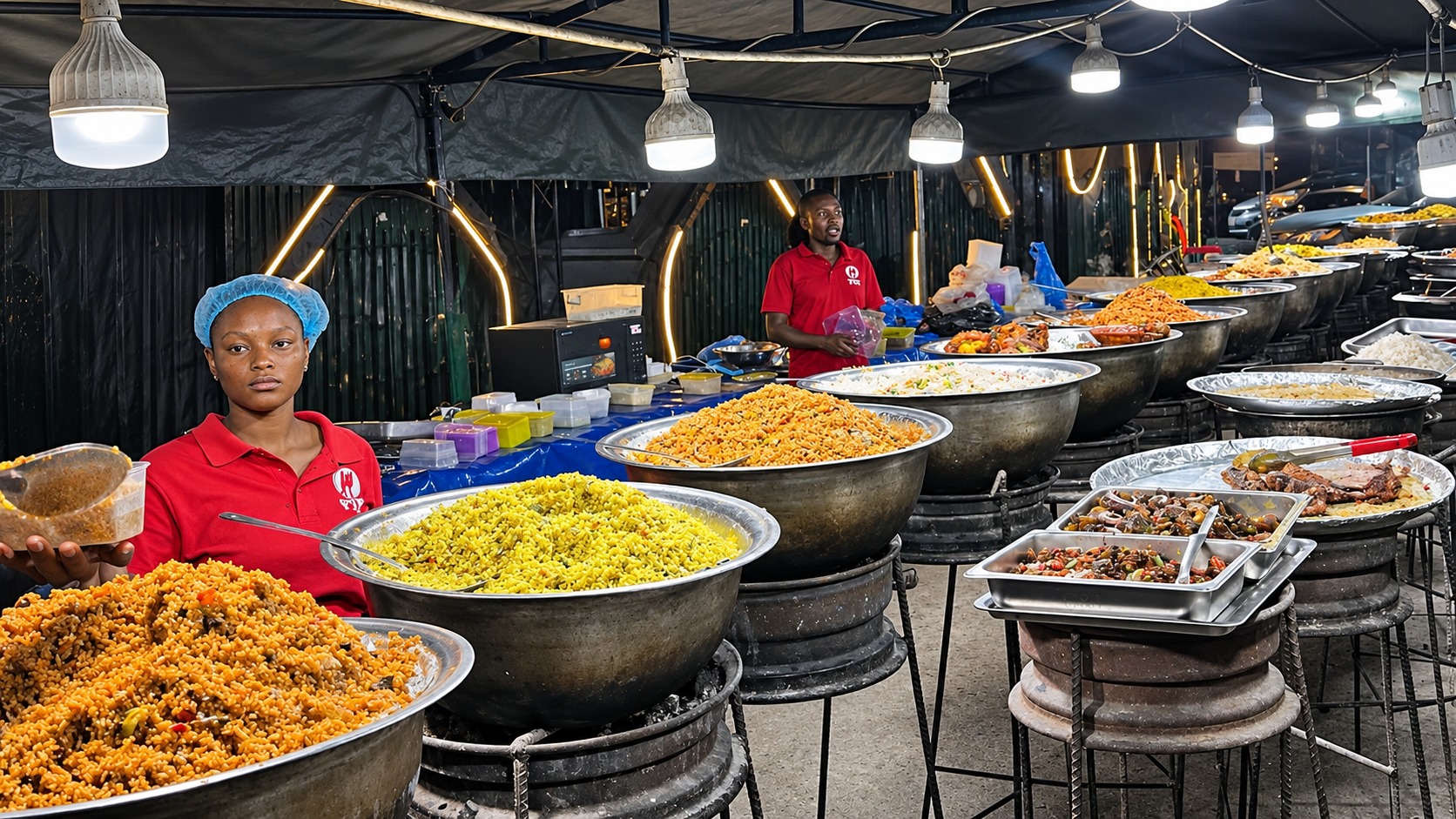
Abuja’s growing night-food economy is drawing workers and late-evening customers toward roadside bukas and informal food stalls, giving small operators a lower-overhead route into hospitality even as high ingredient costs keep margins under pressure.
Recent reporting across the Federal Capital Territory points to a clear shift in everyday food spending. Workers and residents are increasingly choosing informal local restaurants and roadside food vendors because meals are generally cheaper, closer to workplaces and easier to access than conventional restaurants. That same affordability advantage is increasingly visible after dark, when commuters, drivers, artisans, students, security workers and young professionals look for quick meals on their way home or during late shifts.
The result is a more commercially significant night-food market. What used to be treated mainly as a survival trade is increasingly functioning as a flexible small-business model: lower occupancy costs, fast stock turnover, direct cash flow and the ability to follow customer traffic instead of paying for premium restaurant space.
Why demand is moving toward street food
A November 9 survey carried by the News Agency of Nigeria found that FCT workers were increasingly patronising “mama put” outlets as rising food prices made conventional eateries less affordable. Respondents cited three factors repeatedly: price, convenience and proximity.
That demand is not confined to office-hour lunch traffic. A recent Guardian feature on Abuja’s street-buka revival described a growing late-night customer base around roadside grills and food stalls, where ready-made meals, bright lighting, music and high-traffic locations have turned some informal outlets into evening destinations.
For vendors, that matters because demand is becoming broader than a single lunch rush. A stall that captures office workers in the afternoon can also serve commuters, ride-hailing drivers, nightlife customers and other late-evening consumers. Longer trading windows can increase revenue potential without requiring the capital expenditure of a full-service restaurant.
Lower rent changes the economics
The street-food model can reduce one of the biggest barriers to entering Abuja’s hospitality sector: commercial rent. Conventional restaurants must recover the cost of rent, interior fit-out, furniture, power, water, security and staff before they make a profit. Informal food operators can start with a smaller footprint and direct more capital into cooking equipment, inventory and customer-facing presentation.
That cost advantage does not make the business cheap to run. Rice, beans, meat, fish, tomatoes, pepper, cooking oil, gas, packaging and transport remain major expenses. A November 12 market survey in Dei-Dei, Kubwa and Dutse found that food prices remained elevated ahead of the year-end season, with a 50kg bag of local rice selling around ₦72,000–₦80,000 and beans around ₦85,000–₦100,000.
For a night-food vendor, the business challenge is therefore not simply attracting more customers. It is protecting margin while keeping the final plate affordable enough to preserve the very advantage driving customers away from formal restaurants.
The opportunity for small operators
The strongest operators are likely to be those that treat the roadside stall as a real hospitality business rather than an improvised food table. Visible presentation, consistent portion sizes, reliable operating hours, clean serving areas, safe food handling, simple branding and cashless payment options can make a small vendor more competitive without immediately taking on expensive premises.
Location is also central. Bus stops, transport corridors, office districts, residential gateways and areas with evening foot traffic can generate stronger turnover than quieter streets. But operators still have to consider local approvals, traffic obstruction, waste disposal, security and food-safety requirements before committing capital to a site.
There is also a wider supply-chain effect. More night-food outlets mean additional demand for market traders, meat suppliers, vegetable sellers, gas dealers, packaging businesses, dispatch riders, welders, carpenters and small equipment suppliers. The growth of informal dining can therefore create economic activity beyond the vendor selling the final plate.
What Abuja businesses should watch
For entrepreneurs considering the sector, the main question is not whether Abuja residents need affordable food. The more important test is whether a proposed location can generate enough repeat traffic to cover rising ingredient costs while maintaining hygiene and consistent quality.
Existing restaurants should also pay attention. The growth of street bukas is a signal that customers are becoming more price-sensitive and more willing to trade formal ambience for convenience. That creates pressure on mid-market restaurants to rethink portion sizes, takeaway menus, delivery partnerships and lower-cost meal options.
Commercial landlords may feel the effect too. If food entrepreneurs can build strong customer bases without conventional shop space, some operators may delay taking formal leases until they have enough revenue to justify the additional fixed cost.
Practical implications
For food entrepreneurs: start with location economics, daily footfall, food-cost discipline and hygiene systems before spending heavily on décor.
For suppliers: night vendors represent a fragmented but potentially expanding customer base for ingredients, packaging, cooking gas and equipment.
For restaurants: affordability is becoming a more important competitive factor, particularly for workers and commuters.
For investors and SME lenders: informal food businesses can generate regular cash flow, but credit decisions should account for weak record-keeping, volatile ingredient costs and site-security risk.
Abuja’s night-food boom is therefore more than a dining trend. It is part of a wider adjustment in the city’s consumer economy: customers are searching for value, entrepreneurs are looking for lower-cost business models, and more commerce is moving into the hours after the traditional workday.
Related Reads
- Abuja Shop Rents Push More Traders Toward Online Sales
- Seafood Business Booms in Abuja: From Market Stalls to High-End Menus
- How to Start a Business in Abuja
Leave a Reply
You must be logged in to post a comment.