
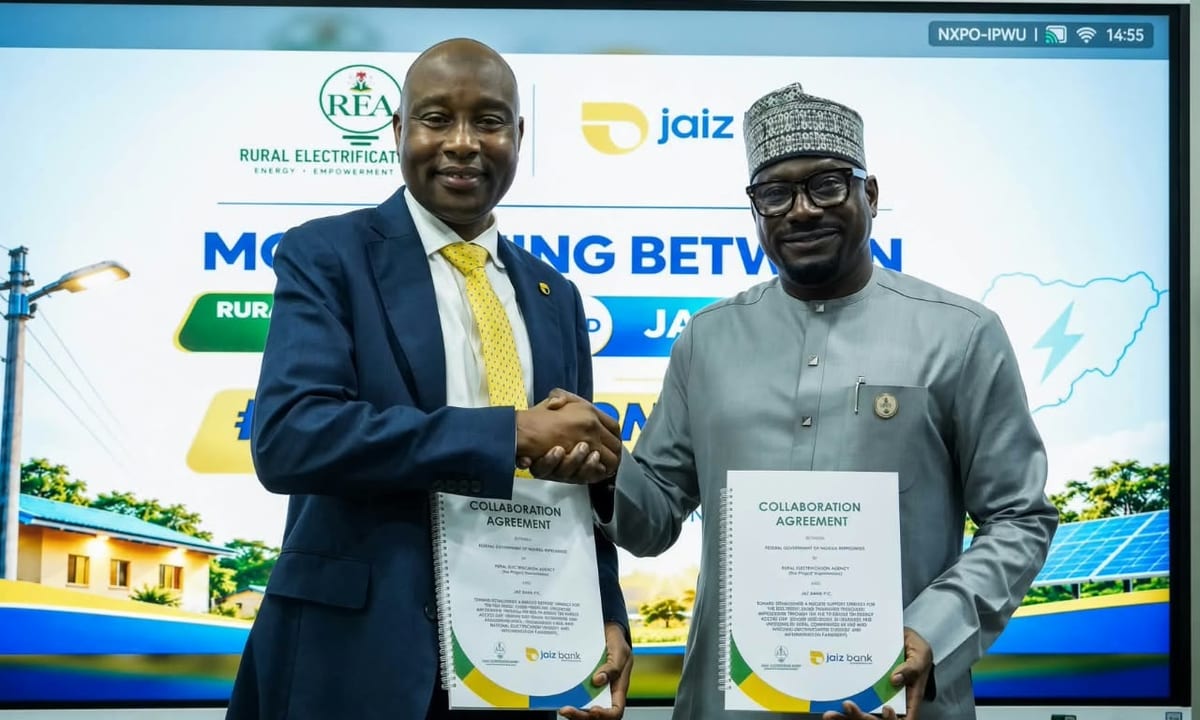
Jaiz Bank and the Rural Electrification Agency have signed a ₦100 billion financing agreement in Abuja, creating a new domestic funding route for renewable-energy developers and lifting the agency’s reported local financing commitments to ₦450 billion.
The memorandum of understanding was signed on Tuesday, 17 November 2026, at REA headquarters in Abuja by Jaiz Bank Managing Director Haruna Musa and REA Managing Director Abba Aliyu. Under the announced structure, Jaiz Bank will support developers’ financing needs, while REA will facilitate the grant agreements linked to qualifying projects.
For Abuja’s finance, legal, engineering and clean-energy businesses, the commercial significance is the prospect of more local capital reaching decentralised electricity projects. The agreement is a financing commitment, however, not evidence that ₦100 billion has already been disbursed or that individual projects have reached financial close.
How the ₦100 billion structure is expected to work
REA said the combination of bank financing and agency-facilitated grant agreements is intended to help renewable-energy developers overcome the funding gap between project preparation and delivery. This is particularly relevant to Renewable Energy Service Companies, or RESCOs, developing mini-grids and other distributed-power systems for communities outside reliable grid coverage.
Jaiz Bank joins Lotus Bank, FCMB, Stanbic IBTC and Alpha Morgan in the agency’s pool of local financing partners. REA said the new agreement takes cumulative domestic commercial financing commitments mobilised for renewable-energy projects to ₦450 billion.
The word “commitments” matters. Public reports reviewed by Abuja Business News did not include a project list, borrower eligibility document, pricing schedule, tenor, security requirements, disbursement timetable or allocation by state. Developers should wait for formal application and transaction documents before building funding assumptions into project plans.
Why the Abuja agreement matters to business
Unreliable electricity raises operating costs for manufacturers, retailers, farms, healthcare providers and digital businesses. Decentralised renewable systems can create productive-use power in markets and communities that are expensive or slow to reach through conventional grid expansion.
If the facility progresses into funded projects, it could generate work for solar and storage suppliers, engineering and construction companies, project developers, financial advisers, insurers, lawyers, environmental consultants, metering providers and operations-and-maintenance contractors. Abuja-based professional firms may be well placed for mandates because REA, Jaiz Bank and many federal approvals and development-finance stakeholders are based in the capital.
The wider economic benefit will depend on whether completed projects deliver reliable power at tariffs households and businesses can afford. Capital availability alone does not resolve land, demand, collection, foreign-exchange, equipment, permitting or operating risks.
Link to the DARES programme
The financing drive sits alongside REA’s Distributed Access through Renewable Energy Scale-up programme, supported by the World Bank. The agency has previously described DARES as a platform for expanding mini-grids and other distributed renewable-energy infrastructure in unserved and underserved communities.
Under results-based structures used in the programme, developers typically need to mobilise capital and complete defined milestones before accessing grant support. That makes bridge and project finance from Nigerian institutions potentially important, but developers must still meet technical, environmental, commercial and documentation requirements.
Practical implications for Abuja businesses
- Renewable-energy developers: prepare audited accounts, project models, demand studies, land documentation, permits, technical designs and evidence of any REA grant award.
- Equipment suppliers: monitor formal procurement and developer requests for solar modules, inverters, batteries, meters, distribution equipment and spare parts.
- Banks and advisers: potential mandates include project appraisal, Sharia-compliant structuring, risk allocation, security documentation, insurance and currency-risk management.
- Engineering contractors: maintain verifiable delivery records, safety systems, environmental compliance and after-sales capacity.
- SMEs seeking power: engage only when service areas, tariffs, connection terms and reliability commitments are documented; the MoU is not yet a customer offer.
- Investors: track signed financing agreements, actual drawdowns, named projects, commissioned capacity and collection performance rather than headline commitment totals alone.
The execution test
The agreement could deepen Nigeria’s local renewable-energy financing market by pairing a non-interest bank with a federal electrification agency. Its credibility will ultimately be measured by capital deployed, projects completed, electricity delivered and businesses served.
The next useful disclosures would be the application route, financing terms, grant interface, eligible technologies, approval process and project pipeline. Until those details are published, the ₦100 billion figure should be treated as an announced financing envelope rather than cash already in the market.
Related Reads
- DBN Launches $275m Climate Finance Programme; Abuja SMEs Can Apply
- NESI Week Moves Abuja Power Investment Gathering to December
- AEDC, FCDA Open Investor Talks on Abuja Waste-to-Power Plant
Sources
- TheCable — REA, Jaiz Bank sign ₦100bn deal to boost electricity access, 18 November 2026.
- BusinessDay — REA, Jaiz Bank sign ₦100bn pact as renewable-energy finance hits ₦450bn, 18 November 2026.
- Punch — Jaiz Bank, REA seal ₦100bn renewable-energy deal, 19 November 2026.
- REA Nigeria Electrification Programme — DARES financing structure and programme context, February 2026.
Leave a Reply
You must be logged in to post a comment.