

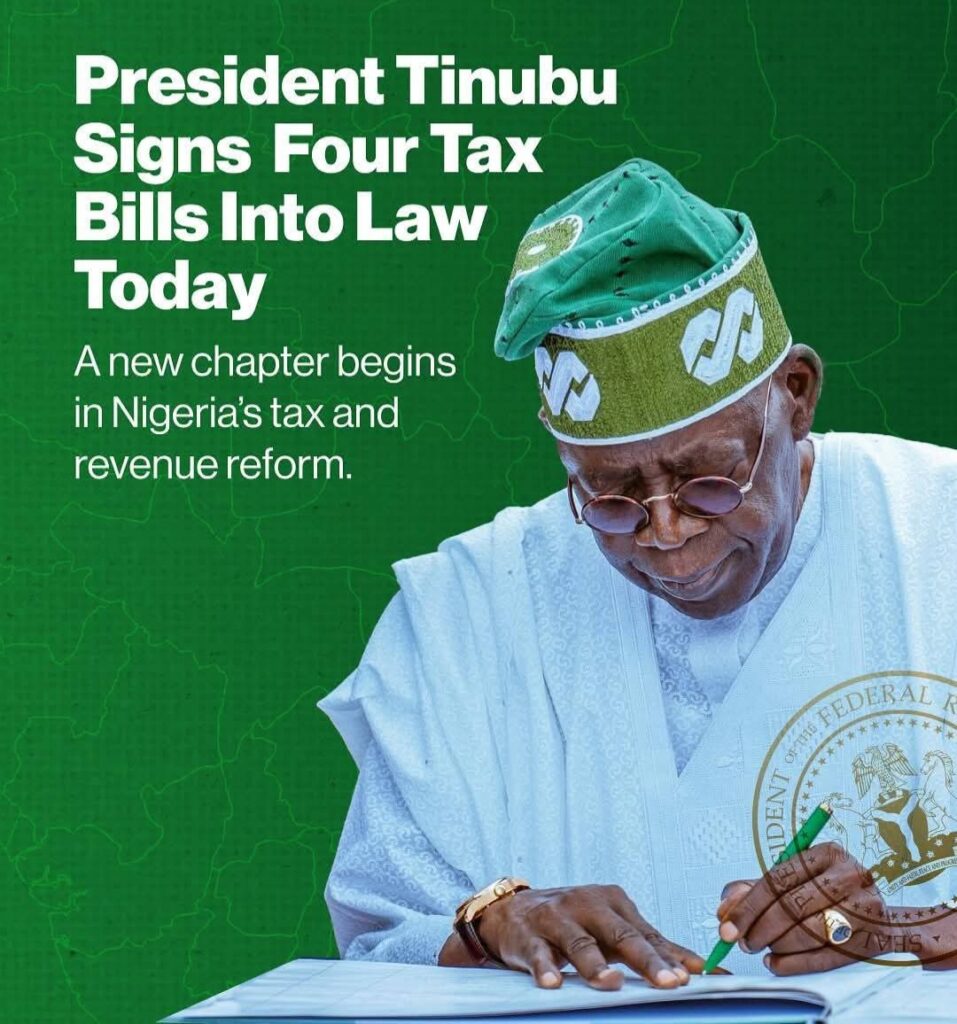
In a major push to streamline Nigeria’s tax system and stimulate economic growth, President Bola Ahmed Tinubu on Thursday signed four transformative tax bills into law, marking one of the most significant fiscal reforms in the country’s recent history.
The new legislation is aimed at harmonizing levies across federal, state, and local governments, improving tax administration, and reducing burdens for small businesses and low-income earners—all while boosting Nigeria’s low tax-to-GDP ratio of 13.5%, which lags behind the African average.
The signed laws are:
- Nigeria Tax Law
- Nigeria Tax Administration Law
- Nigeria Revenue Service (Establishment) Law
- Joint Revenue Board (Establishment) Law
Speaking ahead of the signing ceremony, Tinubu described Nigeria’s previous tax system as “a patchwork—complex, inequitable, and burdensome.” The new laws, he emphasized, will offer relief for everyday Nigerians while bolstering government revenue.
💼 Key Reforms at a Glance:
- Corporate tax reduced from 30% to 25% for eligible companies
- Exemption of small businesses with low turnover from company tax
- A renamed and empowered tax agency: Nigerian Revenue Service (NRS)
- More autonomy and revenue allocation to states from VAT
- A streamlined, digitized national tax system to eliminate multiple taxation and inefficiencies
- Clearer governance frameworks for local government fiscal management
💬 Expert Reactions:
Tax expert Chukwuema Eze described the reforms as a “one-stop shop” that balances revenue growth with equity and simplicity.
“This new regime increases compliance, simplifies procedures, and lightens the load on low-income earners and SMEs. It’s long overdue,” he told AFP.
However, some experts remain cautiously optimistic. Nongomin Joshua of Nongomin & Co. raised concerns about the government’s ability to prudently manage new tax revenues amidst a history of fiscal mismanagement.
“The question isn’t just about new laws—it’s whether the government can efficiently apply them,” he said.
Economist Kelvin Emmanuel, based in Abuja, noted the broader implications:
“This reform can finally move Nigeria’s tax-to-GDP ratio in the right direction. It also lays the groundwork for stronger local government autonomy in managing revenues,” he said.
📉 A Cautious Balancing Act
Earlier drafts of the bills included more aggressive proposals to overhaul the federal revenue-sharing formula—long a sensitive issue between Nigeria’s oil-rich south and economically weaker north. Those clauses were later dropped following political pushback, underscoring the nation’s delicate ethnic and regional balance.
While the reforms have earned praise from global financial observers, they come amid lingering public frustration over economic hardship, rising inflation, and the fallout of earlier decisions like fuel subsidy removal and exchange rate liberalization.
Still, Tinubu’s administration remains bullish on its “Renewed Hope” agenda, hoping that over time, Nigerians will begin to feel the long-term benefits of these structural adjustments.