
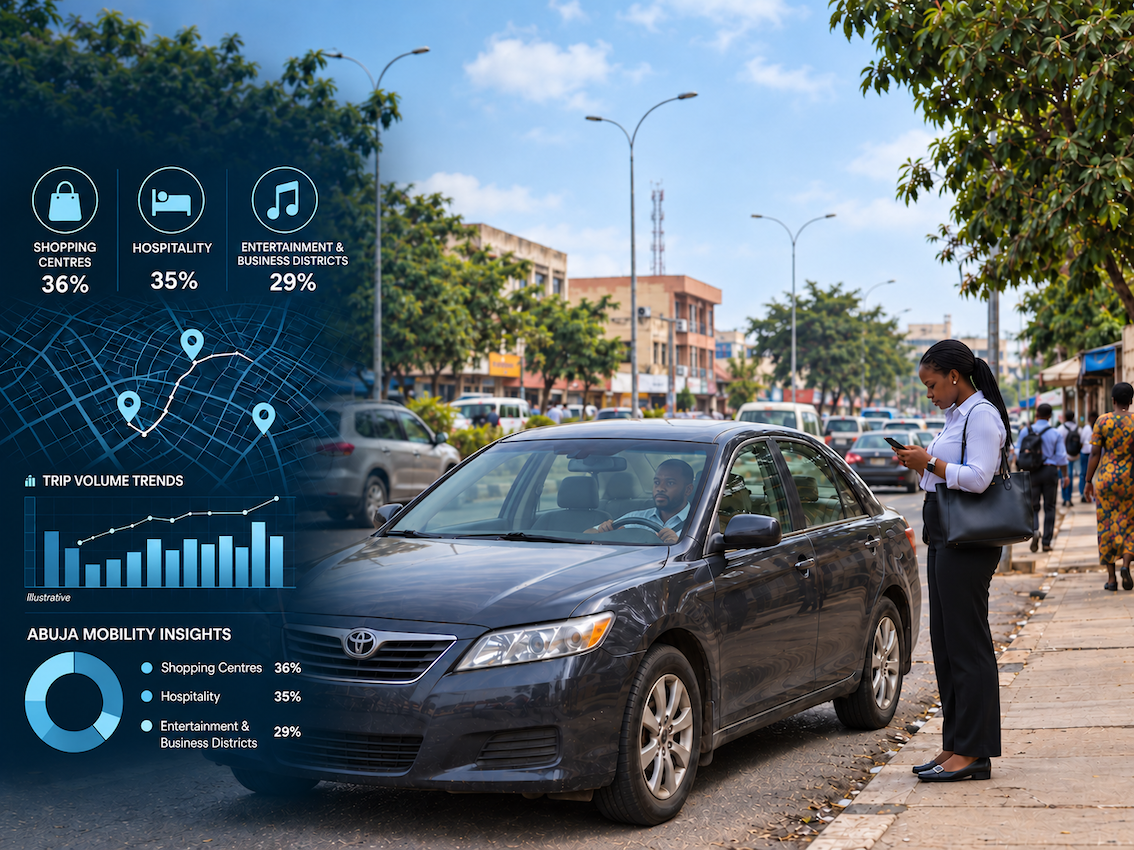
ABUJA — Fresh ride-hailing data is offering one of the clearest real-time signals yet into how Abuja moves, spends, and conducts business.
What appears on the surface as transportation data is, in reality, a deeper reflection of consumer behavior, commercial clustering, and economic activity flows across Nigeria’s capital.
Since launching in Abuja on March 23, 2016, Uber has expanded steadily, evolving from a convenience service into a core layer of the city’s mobility infrastructure — supporting retail, hospitality, nightlife, and institutional movement.
Today, trip patterns are revealing how Abuja truly functions.
Retail Dominates Mobility Flow
Recent analysis shows that 36% of all ride-hailing trips terminate at shopping centres, making retail the single largest mobility driver in the city.
Key destinations include:
- Jabi Lake Mall
- Ceddi Plaza
- Emab Plaza
These locations are no longer just shopping venues — they function as multi-layered economic hubs, combining retail, dining, social interaction, and informal commerce.
The implication is clear:
Abuja’s retail ecosystem is concentrated and mobility-driven.
Ride-hailing is acting as the connector that sustains foot traffic and spending velocity within these hubs.
Hospitality as a Business Engine
Hospitality accounts for 35% of total ride-hailing trips, placing it nearly on par with retail.
High-traffic destinations include:
- Transcorp Hilton Abuja
- Sheraton Abuja Hotel
These are not just accommodation centres — they are transaction environments where business happens:
- Corporate meetings
- Conferences
- Diplomatic engagements
- Executive gatherings
This reinforces Abuja’s positioning as a business and conference capital, where mobility is essential to operational flow.
Entertainment and Institutional Activity
The remaining 29% of trips reflect a broader distribution across lifestyle and institutional movement.
Lifestyle & Night Economy
- BluCabana
- Cubana Abuja
These highlight the rise of a structured after-hours economy contributing to overall commercial activity.
Government & Institutional Movement
- Central Bank of Nigeria
Trips to institutional hubs underscore the continued influence of the public sector in shaping mobility patterns.
What This Data Means
This dataset serves as a high-value intelligence layer:
For businesses:
Location and proximity to mobility corridors directly impact visibility and revenue.
For investors:
Mobility patterns reveal where real demand and spending concentration exist.
For planners and regulators:
Infrastructure demand is clearly clustered around retail and hospitality zones.
For policymakers:
Private-sector data can enhance smarter, more responsive urban planning.
The Bigger Picture
Abuja is evolving into a mobility-driven economic environment where:
- Commerce follows movement
- Visibility follows access
- Growth follows density
Ride-hailing platforms are no longer just transport services — they are becoming real-time indicators of economic activity and urban evolution.
🔗 Related Reads
- Top Real Estate Investment Zones in Abuja
- Where Smart Investors Are Putting Money in Abuja
- Best Businesses to Start in Abuja
💼 Want to Position Your Business or Investment?
Get visibility and connect with customers and investors across Abuja.
Leave a Reply
You must be logged in to post a comment.