
Abuja’s ambition to become a stronger productive and industrial economy is facing a critical question:
How much of the land, capital and infrastructure committed to industrial development in the Federal Capital Territory is actually producing factories, jobs, exports and economic activity?
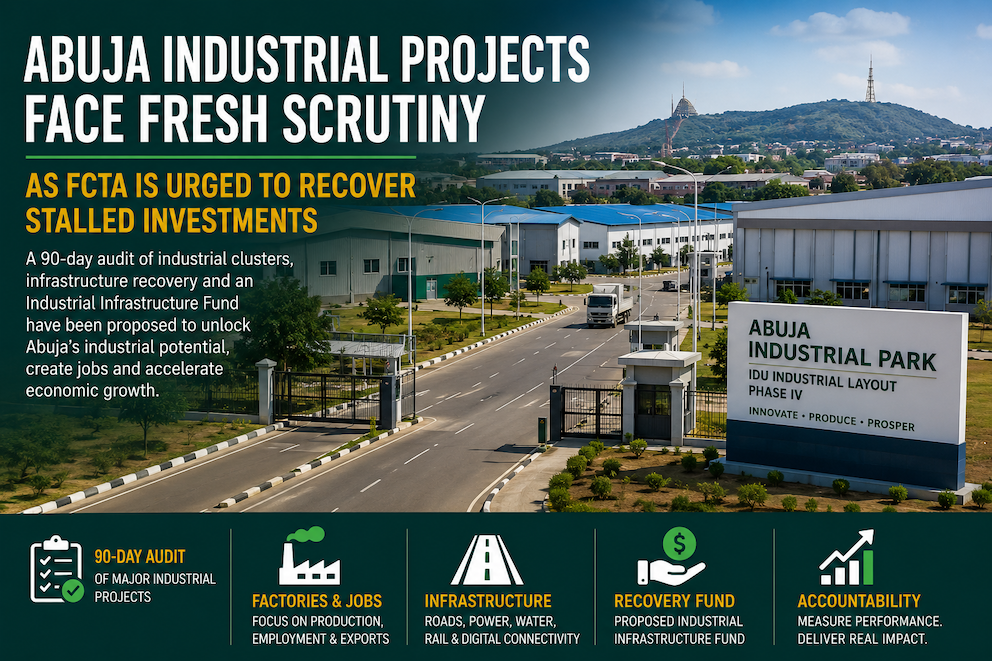
That question has moved into focus following a call for the Federal Capital Territory Administration to conduct a comprehensive audit of major industrial and economic clusters across the FCT and establish mechanisms for recovering stalled investments.
The proposal comes from the Sea Empowerment and Research Centre (SEREC), which argues that Abuja needs to move beyond investment announcements and begin measuring actual economic outcomes.
A 90-Day Audit Has Been Proposed
SEREC has recommended a 90-day comprehensive audit of major industrial and economic clusters in the FCT.
The proposed review would examine:
- Industrial land allocations
- Project beneficiaries and developers
- Original project costs
- Actual capital deployed
- Infrastructure delivered
- Operational businesses and factories
- Jobs actually created
- Tax and revenue contributions
- Outstanding contractual obligations
- Reasons for project delays
The significance of such an audit would extend beyond administrative record-keeping.
It could provide a clearer picture of how much industrial investment Abuja has attracted — and how much of that investment has translated into productive economic activity.
Industrial Land Should Produce Economic Activity
One of the strongest arguments in the proposal concerns the use of industrial land.
Industrial allocations are supposed to support production, manufacturing, logistics, employment and wider economic development.
When strategically located industrial land remains undeveloped or is held primarily for speculative appreciation, the wider economy loses potential factories, businesses, jobs and tax revenue.
Insight: Abuja’s industrial land becomes economically valuable when it supports production — not simply because its market price increases.
From Land Banking to Industrial Production
The policy proposal calls for a shift from land banking to industrial production.
That would mean measuring industrial projects against milestones such as:
- Infrastructure development
- Factory construction
- Equipment installation
- Commencement of production
- Employment creation
- Export performance
- Revenue generation
Where contractual obligations remain persistently abandoned, transparent mechanisms could be used for recovery, restructuring or reallocation.
Abuja Needs Industrial Infrastructure
Land alone does not create an industrial economy.
Factories and industrial businesses require supporting infrastructure capable of making production commercially viable.
Priority infrastructure identified in the proposal includes:
- Access roads
- Reliable electricity
- Water
- Drainage
- Security
- Telecommunications
- Waste management
- Rail connectivity
- Digital infrastructure
Without these systems, industrial land can exist on paper without developing into a competitive production cluster.
An Industrial Infrastructure Recovery Fund
Another proposal is the creation of an FCT Industrial Infrastructure Recovery Fund.
Rather than spreading resources thinly across numerous projects, such a mechanism would concentrate investment on strategic industrial zones where infrastructure completion could unlock private-sector activity.
This approach could be particularly important for manufacturers and investors whose projects depend on infrastructure that individual businesses cannot efficiently provide themselves.
Abuja Industrial Park Shows the Scale of the Opportunity
The wider industrial debate comes as major projects are already taking shape in the capital.
One of the most significant is the Abuja Industrial Park Free Trade Zone at Idu Industrial Layout Phase IV.
The $300 million project covers approximately 250 hectares and is expected to accommodate more than 170 factories when fully operational.
Projections around the development indicate potential employment of approximately 40,000 people.
The project demonstrates what industrial development could mean for Abuja if land, infrastructure and private capital are successfully converted into operating businesses.
Manufacturing Could Diversify Abuja’s Economy
Abuja is commonly associated with government, real estate, hospitality and professional services.
A stronger manufacturing and industrial base would broaden that economic structure.
Industrial development can generate demand across:
- Logistics
- Warehousing
- Construction
- Engineering
- Equipment maintenance
- Professional services
- Packaging
- Transportation
- Technology
This means the economic impact of a successful industrial cluster extends far beyond the factories located inside it.
Abuja Businesses Also Need to Become Investable
Infrastructure is only one side of the equation.
SEREC has also proposed an Abuja Investable Enterprise Programme designed to help businesses improve their ability to attract serious capital.
Areas identified include:
- Corporate governance
- Financial reporting
- Export readiness
- Technology commercialisation
- Development-finance access
- Investor matchmaking
- ESG compliance
- Capital-market preparation
Insight: Increasing the number of registered companies is not enough. Abuja needs more companies capable of attracting capital, expanding production and competing beyond the FCT.
A Case for an Abuja Industrial Productivity Index
Another proposal would create an Abuja Industrial Productivity Index to measure the performance of major industrial clusters annually.
Potential indicators would include:
- Capital deployed
- Infrastructure completed
- Operational factories
- Jobs created
- Local value added
- Exports
- Taxes generated
- Private investment
- Industrial land utilisation
Such reporting could make it easier for businesses, investors and policymakers to distinguish productive industrial projects from projects that exist primarily as announcements or land allocations.
Why This Matters for Investors
Greater scrutiny of industrial projects should not automatically be viewed as negative for investment.
For credible investors, clearer rules and better accountability can improve confidence.
Investors need to know:
- Who controls industrial land
- Which infrastructure will be delivered
- What development milestones apply
- Which agencies are responsible
- How disputes and abandoned projects will be handled
A transparent industrial framework could therefore make Abuja more attractive to serious long-term capital while discouraging speculative land holding.
The Bigger Abuja Economic Question
Abuja has already demonstrated its ability to generate substantial economic activity from government, property, services and consumption.
The next stage is more difficult.
Can the capital build a stronger productive economy based on factories, technology companies, exporters, logistics enterprises, innovation hubs and globally competitive businesses?
That is where industrial policy becomes important.
Final Thoughts
Abuja’s industrial opportunity is substantial, but industrialisation cannot be measured by the number of estates announced or hectares allocated.
It has to be measured by what is actually produced.
Factories operating. Jobs created. Capital deployed. Products exported. Infrastructure completed. Taxes generated.
If the FCT can convert more of its industrial land and stalled projects into functioning economic assets, Abuja could begin building a much broader identity — not only as Nigeria’s administrative and investment capital, but as an increasingly important centre of production.
Related Reads
- Why Abuja Is Quietly Becoming Nigeria’s New Investment Capital in 2026 “`
- Where Smart Investors Are Putting Money in Abuja
- Best Business Opportunities in Abuja Right Now
- Explore Abuja Business Directory “`
Want to Position Your Business in Abuja?
Abuja Business News provides visibility for companies, investors and business leaders participating in the capital’s changing economy.