
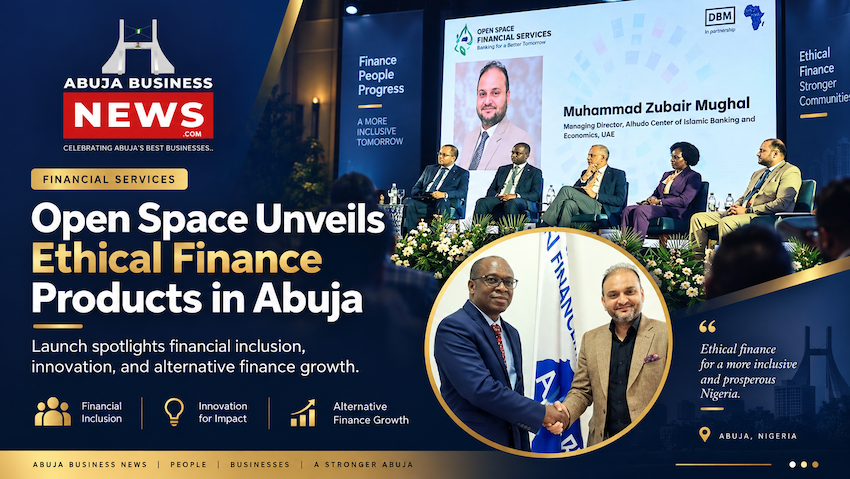
Abuja-based Open Space Financial Services Limited has launched a new suite of ethical and non-interest financial products designed to widen access to capital, productive assets and investment opportunities for individuals, entrepreneurs and businesses.
The products were unveiled in Abuja as the company expands its financial services platform beyond conventional transactions into asset-backed financing, leasing, shared ownership and profit-sharing investment structures.
Open Space, which maintains its head office at Novare Central Mall in Wuse Zone 5, is positioning the initiative as part of a wider effort to make finance more accessible to people and businesses that may be underserved by conventional credit products.
Four financing structures form the new offering
The company is introducing four main structures: Murabaha, Ijarah, Diminishing Musharakah and Mudaraba.
Although based on Islamic-finance principles, Open Space says the products are intended for a broad customer base rather than any single religious or demographic group.
The underlying proposition is to connect financing and investment to identifiable economic activity rather than conventional interest-bearing lending.
Murabaha targets business and asset purchases
Under the Murabaha model, Open Space purchases an approved asset required by a customer and resells it at a disclosed cost plus an agreed profit.
This structure can potentially support businesses seeking equipment, inventory, vehicles or other productive assets without using a conventional interest-based loan.
For Abuja SMEs, the model could be relevant across sectors such as transportation, healthcare, professional services, retail, construction, hospitality and other businesses where equipment acquisition can represent a significant barrier to expansion.
Ijarah introduces an alternative leasing structure
Ijarah is structured around leasing rather than conventional borrowing. Customers gain access to approved assets for an agreed period under defined contractual terms.
The model may be applicable to businesses that need productive assets but do not necessarily want to purchase them outright at the beginning of the commercial relationship.
Equipment leasing can be particularly relevant to SMEs operating in logistics, construction, healthcare, agriculture, manufacturing and professional services.
Diminishing Musharakah creates a route to ownership
Open Space is also introducing Diminishing Musharakah, a shared-ownership structure under which the company and a customer jointly acquire an asset.
The customer then progressively purchases Open Space’s ownership units until eventually becoming the sole owner.
The structure can potentially be applied to major asset-acquisition needs, including property and productive business equipment.
For business owners, the significance is the shift from a conventional lender-borrower relationship toward a financing model based on partnership and progressive ownership.
Mudaraba links investment capital to productive activity
The fourth structure, Mudaraba, operates as a profit-sharing investment arrangement.
Customers provide capital while Open Space manages the funds through Shariah-compliant investments, with profits shared according to pre-agreed ratios.
The company has identified areas such as SME financing, trade finance, leasing and other asset-backed activities as potential destinations for investment capital.
Why this matters for Abuja businesses
Access to affordable and appropriate financing remains one of the most important issues facing Nigerian businesses.
For Abuja entrepreneurs, the challenge can be particularly visible among businesses attempting to acquire vehicles, equipment, commercial property, technology, inventory or other assets required to scale.
Alternative financing models broaden the range of structures available to businesses that may not want, qualify for or prefer conventional interest-bearing loans.
The commercial test will be whether these products can provide competitive, transparent and accessible financing under real operating conditions.
Technology forms part of the strategy
Open Space is also positioning technology as a central part of its financial services model.
The company operates a broader digital ecosystem covering payments, savings, investment, business tools and other financial services, while its ethical finance products are intended to integrate into the same platform.
The company has also highlighted the use of artificial intelligence and digital tools to support financial decision-making and customer experience.
Abuja becomes the launch point for a broader financial strategy
Open Space’s Abuja headquarters gives the capital another financial-technology operator attempting to build products for both consumers and businesses.
Abuja’s concentration of entrepreneurs, professional-service firms, institutions, government agencies, property businesses and SME operators makes it a relevant environment for testing alternative financing models.
The company also operates in Lagos and lists an international presence in Toronto, suggesting ambitions beyond the Abuja market.
Non-interest finance is becoming more mainstream
Ethical and non-interest finance has historically been viewed by some customers as a specialised segment of the financial system.
That perception is gradually changing as financial institutions increasingly market asset-backed, partnership-based and profit-sharing structures to a wider commercial audience.
For SMEs, the attraction is less about terminology and more about whether financing structures can help businesses acquire productive assets at a sustainable cost.
What businesses should examine carefully
As with any financing product, businesses should assess the complete commercial terms before committing.
Important considerations include:
- total acquisition or financing cost;
- payment and ownership structure;
- fees and administrative charges;
- security or collateral requirements;
- early-settlement provisions;
- responsibility for insurance and maintenance;
- default provisions; and
- the legal documentation governing the transaction.
The absence of conventional interest does not remove the need for careful financial due diligence.
Another signal from Abuja’s expanding fintech market
The launch also highlights the growing diversity of Abuja’s financial and technology ecosystem.
The capital is increasingly home to fintech companies, payment businesses, investment platforms, microfinance operators, insurance businesses and technology-enabled professional-service firms.
Open Space’s move into non-interest and ethical finance adds another model to that expanding market.
The next indicators to watch will be actual customer adoption, financing volumes, SME participation and how competitively the products perform against conventional credit and leasing alternatives.