
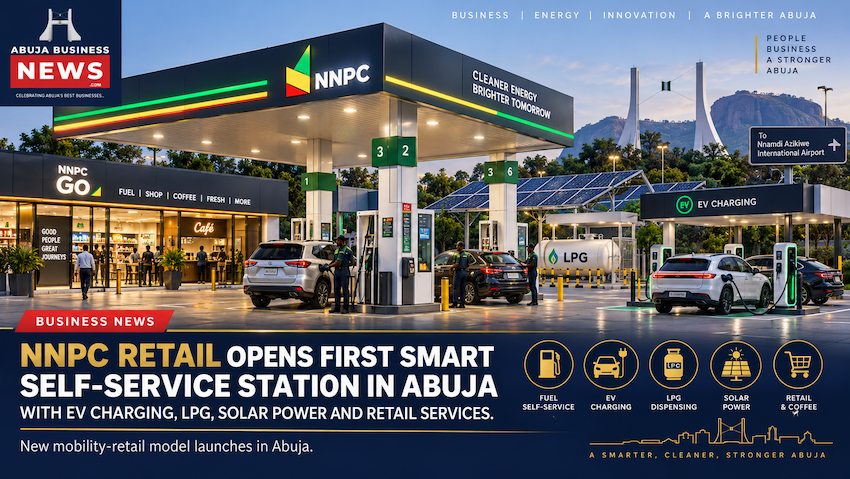
Abuja has become the launch market for NNPC Retail Limited’s first Smart Self-Service Station, introducing a more automated and diversified fuel-retail model that combines conventional fuel sales with electric vehicle charging, LPG, solar power, automotive services and lifestyle retail.
The new facility was commissioned on September 10, 2026, along Bill Clinton Drive in Abuja and represents a major shift from the traditional petrol-station format toward a broader mobility and convenience-retail platform.
The project was developed by NNPC Retail Limited in partnership with the Nigeria Immigration Service, which provided land for the facility.
A different model for fuel retail in Abuja
Unlike conventional filling stations where attendants typically complete fuel transactions, the new Abuja station features a 24-hour self-service system that allows motorists to select the quantity of fuel they want and complete payments independently.
For NNPC Retail, the concept signals a move toward greater automation, customer control and integration of multiple mobility services within a single commercial location.
The company said the model is designed around changing customer expectations and will form part of a broader expansion of technology-enabled retail infrastructure.
16 petrol pumps and an 86-point EV charging hub
The Abuja Smart Station includes 16 Premium Motor Spirit pumps and two Automotive Gas Oil pumps.
According to NNPC, the facility has storage capacity for 180,000 litres of PMS and 5,000 litres of AGO.
One of its most significant features is an electric vehicle charging facility with capacity for 86 charging points, developed in partnership with Africa Motor Works.
That component gives the project relevance beyond petroleum retail. It places Abuja among the markets where operators are beginning to invest in supporting infrastructure for a possible expansion of electric mobility.
Solar power changes the operating model
The station is powered entirely by more than 200 kilowatt-hours of installed solar capacity.
For businesses operating large retail or service facilities in Abuja, the energy model is notable because electricity costs remain an important operational consideration.
Integrating solar power at this scale reduces dependence on conventional electricity supply and diesel generation while allowing the station to support fuel retail, charging infrastructure and other commercial services.
More than a filling station
The project also includes an LPG dispensing facility, lubricant service bay and fully automated car wash.
Space has additionally been provided for quick-service restaurants, a coffee shop and a convenience store.
This combination moves the site closer to the modern mobility-hub model seen in more developed retail markets, where customers can combine refuelling or charging with dining, shopping, vehicle servicing and other convenience services.
Provision has also been made for the future installation of Compressed Natural Gas infrastructure.
New commercial opportunities around mobility
The development is relevant to Abuja businesses because modern service stations increasingly create commercial opportunities beyond fuel margins.
Retail tenancy, food and beverage concessions, convenience shopping, vehicle maintenance, charging services, advertising, logistics and fleet services can all form part of the economics of a large mobility hub.
For restaurant operators, coffee brands and convenience retailers, this type of infrastructure can also create new high-traffic commercial locations.
EV infrastructure remains an emerging market
Nigeria’s electric vehicle market is still developing, but charging infrastructure is one of the conditions required before adoption can grow substantially.
By installing an 86-point charging facility in Abuja, NNPC Retail is making an early infrastructure investment in a market that could become increasingly important as vehicle manufacturers, fleet operators and consumers explore alternatives to conventional petrol and diesel vehicles.
The business case will depend on utilisation, vehicle adoption, electricity economics and the commercial model for charging, but the scale of the Abuja installation makes the development significant.
Airport corridor gains another commercial asset
The Bill Clinton Drive and Airport Road axis is one of Abuja’s strategically important transport corridors, connecting the city with Nnamdi Azikiwe International Airport and major residential and commercial areas.
A large mobility facility in this corridor can potentially serve private motorists, commercial fleets, airport-related traffic, logistics operators and travellers.
It also adds another commercial asset to an area that continues to attract logistics, hospitality, residential and infrastructure investment.
NNPC plans wider rollout
NNPC Retail says the Abuja facility is intended to be the first of a wider rollout of Smart Stations across Nigeria.
Mumuni Dagazau, Executive Vice President, Downstream at NNPC Ltd, said the development represents another step in the evolution of the company’s retail business and reflects an effort to build a more convenient, technology-enabled network.
If the model proves commercially viable, similar sites could reshape the traditional economics of petrol retail by combining energy sales with vehicle services, food, convenience retail and charging infrastructure.
What Abuja businesses should watch
The most important question is not simply whether customers will use self-service petrol pumps.
The larger business signal is that one of Nigeria’s biggest energy companies is experimenting in Abuja with a more diversified retail format built around mobility, technology and customer experience.
Businesses should watch how quickly the EV charging component attracts demand, which food and retail operators take space at the site, how consumers respond to self-service fuelling and whether NNPC replicates the model at additional Abuja locations.
If those elements gain traction, the station could become an early indicator of how Nigeria’s downstream retail market may evolve over the next several years.