
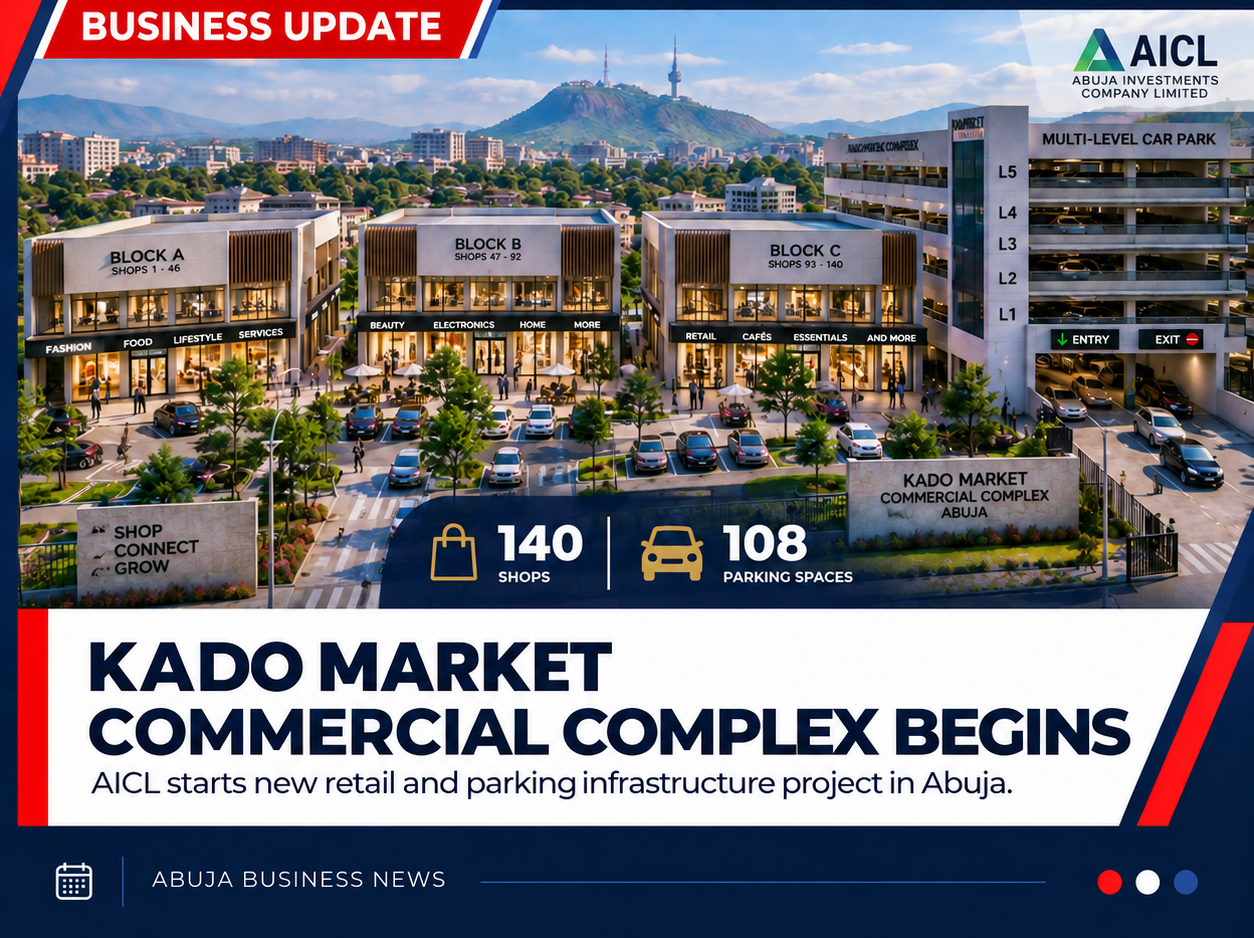
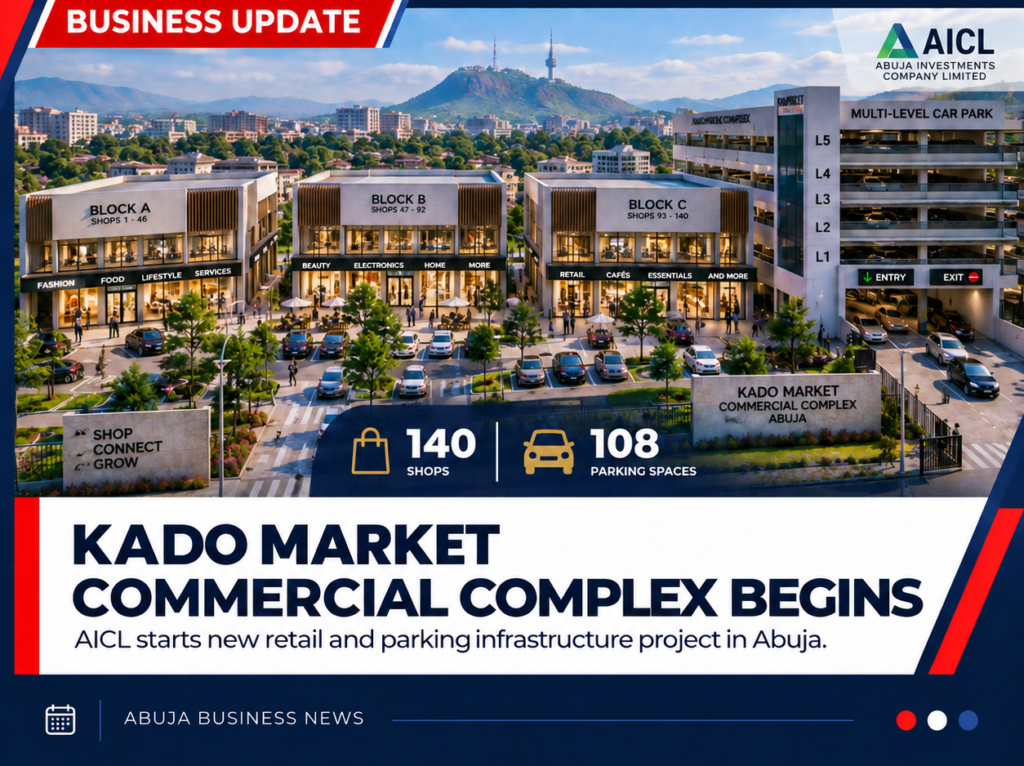
Abuja Investments Company Limited has commenced construction of a new commercial complex and multi-level car park at Kado Market, adding 140 shops and 108 parking spaces to one of the Federal Capital Territory’s established trading areas.
The project was unveiled at a groundbreaking ceremony in Abuja and combines new retail infrastructure with a purpose-built parking facility intended to improve commercial activity, circulation and the operating environment around the market.
For Abuja’s business community, the development is significant because it links commercial real estate directly with market infrastructure, trader capacity and the practical problems created by congestion and limited organised parking around busy retail locations.
Kado Market is gaining new organised commercial capacity through a 140-shop complex and a five-level parking structure designed for 108 vehicles.
What is being built at Kado Market
According to Vanguard, the commercial component will comprise three blocks built across two suspended floors, providing a total of 140 shops of varying sizes.
A separate purpose-built multi-level car park is planned across five suspended floors with capacity for 108 vehicles.
The combination addresses two different commercial requirements at the same time: increasing the amount of formal retail space available to businesses while improving vehicle management around the market.
AICL positions the project as commercial infrastructure
Abuja Investments Company Limited is the investment and holding company of the Federal Capital Territory and is wholly owned by the Federal Capital Development Authority.
Its official mandate includes investment development, commercial infrastructure, asset management and partnerships intended to create economic value within Abuja.
At the groundbreaking, AICL Group Managing Director and Chief Executive Officer, Ambassador Maureen Tamuno, said the Kado development was intended to support traders and entrepreneurs while creating a more organised commercial environment.
The project therefore sits at the intersection of public asset development and private-sector participation rather than functioning simply as another standalone shopping property.
Parking could be as important as the additional shops
In busy Abuja markets, parking and traffic circulation directly affect customer experience, delivery activity and the ability of traders to operate efficiently.
A commercial centre may contain attractive retail units, but persistent congestion can reduce accessibility, complicate loading and unloading and discourage customers who cannot conveniently reach businesses.
The planned 108-space parking facility is therefore commercially relevant in its own right. If well managed, it could improve access to the market while reducing some of the pressure created by roadside and informal parking.
140 additional shops create new operating space
The new retail component is expected to provide additional formal trading space for businesses operating in and around Kado.
Potential beneficiaries could include retailers, distributors, service providers, food businesses and other SMEs seeking organised commercial premises within the district.
The value of those units will ultimately depend on factors such as pricing, service charges, access, foot traffic, unit sizes, allocation terms and the quality of facility management.
Those commercial details have not yet been fully disclosed publicly, so prospective occupants or investors should rely on official project documentation when units become available rather than assuming specific returns or rental economics.
Private partners are involved in delivery
AICL identified Westwood Universal Link Limited as a development partner on the project.
The Managing Director of Halibiz Flexible & Smart Homes Limited, Adamu Aliyu, also said his company expected the project to be completed within approximately 12 weeks.
That timeframe is a contractor-stated delivery target rather than a guaranteed completion date, and actual delivery will depend on construction progress and site conditions.
Why Kado matters commercially
Kado sits within a wider commercial and residential corridor linking parts of Jabi, Life Camp, Gwarinpa, Mabushi and other fast-growing areas of Abuja.
As surrounding residential development increases, local markets and retail centres can benefit from larger customer catchments and higher demand for everyday goods and services.
This creates opportunities not only for shop owners but also for logistics providers, payment companies, security firms, cleaners, maintenance contractors, food operators and other service businesses supporting market activity.
Market infrastructure is becoming a bigger investment theme
Abuja’s commercial real-estate conversation often focuses on office towers, mixed-use developments and premium retail, but organised markets remain a critical part of the city’s business infrastructure.
Markets provide operating space for SMEs and traders while supporting wholesale distribution and consumer access across multiple sectors.
Improving these facilities can therefore have a wider economic impact than the number of new units alone suggests.
AICL has a wider market-management footprint
AICL’s market interests are supported by Abuja Markets Management Limited, its market-management subsidiary.
AMML says it has expanded its management footprint to 24 markets across the Federal Capital Territory since beginning operations in 2005.
The company’s stated focus includes facility management, service-charge administration, trader support, security and creating safer and more organised market environments.
The Kado development therefore fits into a broader effort to treat Abuja’s markets as structured commercial assets rather than informal trading spaces alone.
What the project could mean for traders
For existing and prospective traders, the most important questions will concern affordability and access.
New market infrastructure can improve operating conditions, but its commercial impact depends on whether the units can be occupied by viable businesses at sustainable costs.
Businesses considering space should examine:
- shop purchase or rental terms;
- service charges and facility-management costs;
- parking and delivery arrangements;
- unit size and permitted business use;
- security and operating hours;
- customer footfall and accessibility; and
- the legal and contractual framework governing occupancy.
Construction could create short-term business demand
The construction phase itself can also generate economic activity before the complex opens.
Projects of this type require building materials, skilled and unskilled labour, logistics, equipment, professional services, security and other inputs.
Local suppliers and contractors may therefore benefit indirectly from the development depending on the project’s procurement structure.
The broader signal for Abuja commercial property
The Kado project adds to a wider pattern of commercial infrastructure investment across Abuja.
As population and business activity spread across new districts and established neighbourhoods, the demand for organised retail, parking, logistics and market facilities is likely to grow alongside residential development.
For investors, this creates a different commercial-property opportunity from conventional offices or residential estates: assets whose value is directly linked to active trading, customer traffic and market operations.
What Abuja businesses should watch next
The immediate indicators will be construction progress, the release of shop-allocation or investment terms and whether the proposed 12-week delivery target is achieved.
Businesses should also watch how the new parking structure is operated and whether the project materially improves congestion and customer access around the market.
If the development succeeds operationally, it could provide a useful model for combining retail expansion with traffic and parking solutions at other busy Abuja markets.
Sources: Vanguard; Abuja Investments Company Limited; Abuja Markets Management Limited.
Leave a Reply
You must be logged in to post a comment.