
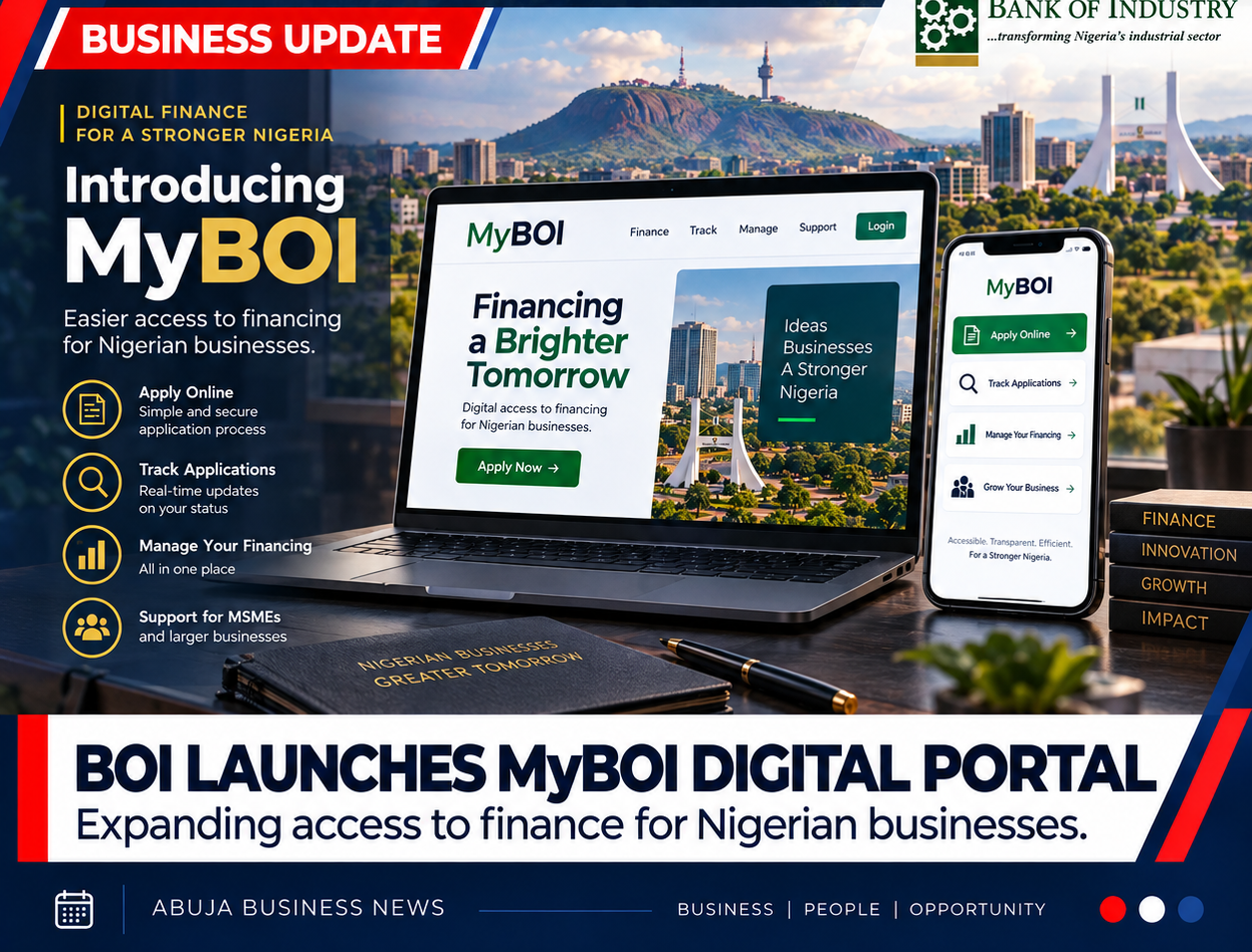
The Bank of Industry has launched MyBOI, a new end-to-end digital financing portal designed to make it easier for Nigerian businesses to apply for development finance, track applications and manage parts of the funding journey online.
The launch comes days after BOI’s 2026 Annual Public Lecture in Abuja, where the bank called for a deeper pool of long-term capital to support industrial growth, productive investment and businesses that remain underserved by conventional finance.
For Abuja-based SMEs and companies across Nigeria, the development matters because access to funding is not only about whether money exists. It is also about how easily businesses can understand eligibility, submit documentation, follow an application and move through the financing process.
BOI is moving more of its financing journey online while simultaneously arguing that Nigeria needs significantly more patient, long-term capital for productive businesses and industrial expansion.
MyBOI goes live as a digital financing gateway
BOI’s official website lists 2 October 2026 as the launch date for the MyBOI Portal, describing it as a platform through which businesses can apply, track and manage loan applications.
According to reporting from The Guardian, the portal is designed to support onboarding, impact and sustainability assessments, financing applications and digital tracking of application progress.
The platform is intended for micro, small and medium enterprises, larger businesses, cooperatives, associations and other eligible customers.
That is commercially relevant because many SMEs have historically found development-finance applications difficult to navigate, particularly where documentation, branch visits, follow-up and application visibility are concerned.
BOI is targeting a faster application process
The bank has set measurable adoption and efficiency targets around the platform.
According to The Guardian, BOI expects MyBOI to reduce front-end application initiation time by at least 40 per cent within nine months.
The institution is also targeting a 30 per cent increase in qualified digital financing applications within 12 months and at least 60 per cent self-service adoption for new applications over the same period.
Those are BOI targets rather than achieved outcomes, so the real test will be whether applicants experience meaningfully shorter processing journeys and greater transparency once usage scales.
Abuja lecture puts long-term capital back at the centre
The digital launch follows BOI’s Annual Public Lecture held on 29 September 2026 at Fraser Suites in Abuja under the theme “Rethinking Capital for Inclusive Economic Transformation.”
The event brought together policymakers, development-finance leaders, industry executives and academics to discuss how capital should be mobilised and deployed to support Nigeria’s industrialisation and inclusive growth.
BOI Managing Director and Chief Executive Officer Dr Olasupo Olusi used the platform to argue that Nigeria needs more long-term capital directed toward productive sectors and businesses capable of generating measurable economic impact.
The underlying issue is familiar to many Abuja businesses: short-term commercial credit does not always match the financing needs of manufacturers, healthcare providers, processors, infrastructure businesses and other companies that need years rather than months to generate returns from major investments.
BOI says its 2025 interventions reached significant scale
BOI’s own 2025 Development Impact Report, released earlier this year, recorded approximately ₦644.9 billion in disbursements and said the bank’s interventions supported about 1.68 million jobs.
At the 2026 Abuja lecture, Olusi cited roughly ₦645 billion in 2025 disbursements to more than 12,000 businesses, according to The Guardian.
The figures underline BOI’s scale as a development-finance institution, but the more important question for individual businesses is whether funding can reach viable companies more efficiently and predictably.
Who can use the MyBOI financing process?
BOI’s official MyBOI guidance says registered Nigerian businesses can apply, subject to eligibility, documentation, cashflow assessment and credit requirements.
Typical requirements may include:
- CAC registration documents;
- a verifiable business bank account;
- BVN information for business owners or directors;
- business bank statements;
- valid identification;
- Tax Identification Number where applicable;
- sector-specific regulatory licences where required; and
- proforma invoices or other documentation linked to the proposed use of funds.
BOI also says audited financial statements are generally not mandatory for micro facilities below ₦10 million, while larger facilities may require audited accounts.
Digital does not mean automatic approval
The most important point for SMEs is that a digital application is still a credit application.
BOI says facility requests remain subject to appraisal, legal and compliance checks, creditworthiness assessment, cashflow analysis and the institution’s internal risk policies.
Depending on the facility, security may include collateral, guarantees, mortgages, debentures or other forms of credit support.
Businesses should therefore avoid treating MyBOI as an instant-loan application. The platform may simplify the process, but applicants still need to demonstrate that the business is viable and capable of repaying the facility.
Why this matters to Abuja SMEs
Abuja has a large base of service companies, contractors, healthcare businesses, hospitality operators, technology firms, retailers, property businesses and professional-service SMEs.
Many of those businesses reach a point where growth requires more capital than internal cashflow can provide.
Examples include:
- purchasing equipment or machinery;
- financing larger inventory positions;
- opening a new location;
- fulfilling major supply contracts;
- expanding production capacity;
- acquiring commercial vehicles; and
- investing in technology or energy infrastructure.
A more accessible development-finance process could therefore be commercially useful if the underlying financing products are appropriate for the business and the approval timeline is competitive.
Businesses should prepare before applying
Digitisation makes it easier to submit information, but weak documentation can still slow or stop an application.
Businesses considering BOI financing should be able to clearly explain:
- how much funding is required;
- what the funds will be used for;
- current turnover and cashflow;
- how the investment will increase revenue or productivity;
- the expected repayment source;
- existing financial obligations; and
- the security or guarantees available where required.
Companies should also ensure that corporate records, bank statements and regulatory documents are current before beginning the process.
Technology could improve visibility for applicants
One of the potential benefits of a fully digital financing platform is better visibility into application status.
Traditional financing processes can leave applicants uncertain about whether documentation has been received, what stage an application has reached or whether additional information is required.
If MyBOI delivers clearer tracking and communication, that could reduce some of the administrative uncertainty experienced by businesses seeking development finance.
The quality of that user experience will be worth monitoring as more companies begin using the portal.
The bigger issue remains the availability of long-term capital
BOI’s digitisation effort addresses the process of accessing finance, but the Abuja lecture focused on the other side of the equation: the amount and structure of capital available to Nigeria’s productive economy.
Former World Bank Director and Georgetown University Adjunct Professor Asad Alam argued at the lecture that productivity, technology, human capital and institutional strength must complement physical capital as economies develop.
Special Adviser to the President on Economic Affairs Tope Fasua emphasised that sectors such as power, logistics and infrastructure still require substantial capital investment.
Together, those perspectives highlight a central challenge for Nigerian businesses: the country needs both more capital and more productive deployment of that capital.
Official BOI resources
What Abuja businesses should watch next
The launch of MyBOI is a meaningful operational change, but its business impact will become clearer over the next year.
Key indicators will include application-processing times, approval rates, self-service adoption, applicant experience and how much financing reaches SMEs and productive businesses through the digital channel.
For Abuja-based companies, the practical opportunity is straightforward: businesses that need long-term development finance now have a more digital route into BOI’s financing process, but they still need strong records, clear cashflows and a credible investment case.
Sources: The Guardian; Bank of Industry; BOI Annual Public Lecture 2026; BOI 2025 Development Impact Report.
Leave a Reply
You must be logged in to post a comment.