
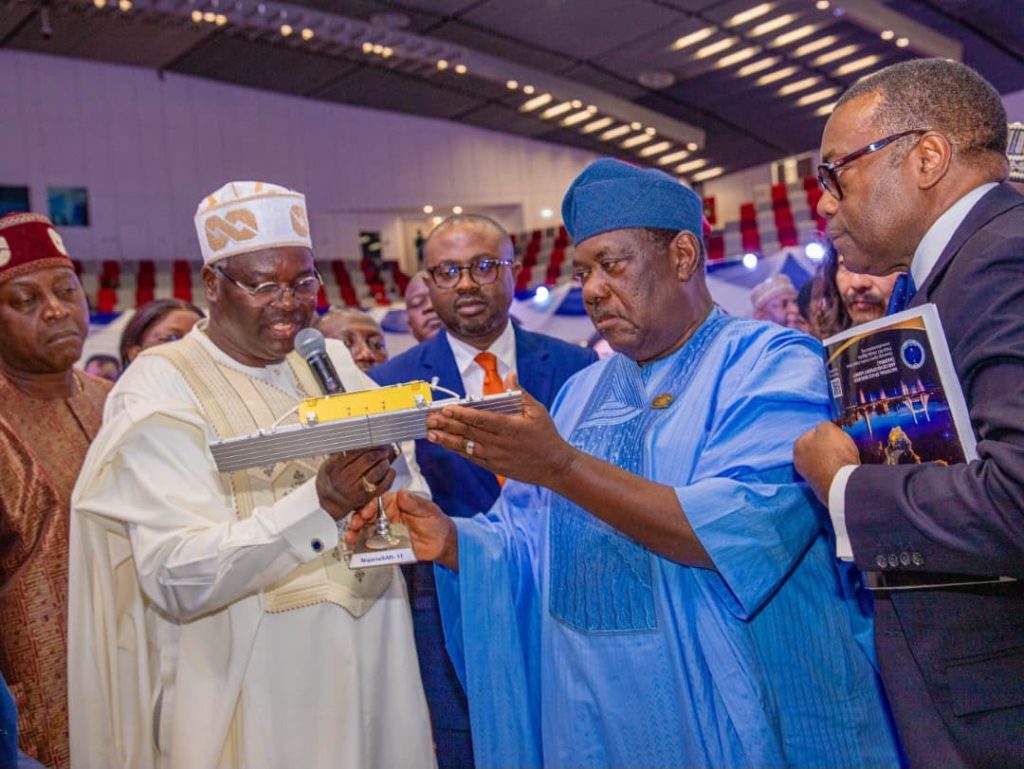
Nigeria’s space agency presented models of its proposed Earth-observation satellites in Abuja on 24 November 2026, moving the discussion at the Africa Space Economy, Innovation and Communication Conference (ASEICC) from a scheduled investment forum to a tangible demonstration of planned technology. For local software developers, surveyors, agritech firms and engineering suppliers, the commercial question is how future satellite data and domestic technical capacity could translate into paid services.
The National Space Research and Development Agency (NASRDA) reported the unveiling on Tuesday, the opening day of ASEICC 2026. PUNCH separately reported the presentation of optical and radar satellite models at the conference, citing a statement from the office of the Secretary to the Government of the Federation. The presidential address was delivered by the Secretary to the Government of the Federation, George Akume.
The development is distinct from Abuja Business News’ 22 November preview of the conference. It is also separate from the regional ECOSAT-1 design-validation process reported on 21 November. The latest presentation concerns proposed Nigerian satellite platforms, not a launch or the commencement of a commercial satellite service.
From satellite models to a market for data
NASRDA described proposed optical and synthetic aperture radar Earth-observation platforms and plans for onboard data processing. The intended applications include agricultural analysis, environmental monitoring, infrastructure planning and disaster response. The designs offer a basis for discussions about future services, but the unveiling itself does not establish that the spacecraft have been manufactured, placed in orbit or made available to customers.
Earlier reporting by Space in Africa on 12 November placed the procurement process for four Earth-observation satellites at the bidder-recommendation stage, with contract awards awaiting further approval. The 24 November presentation does not, by itself, establish that those awards have since been made. No contract price or delivery date for these platforms was established by the unveiling reports reviewed.
Local technical capacity is another commercial question
NASRDA’s account also highlighted its assembly, integration and testing building and ground-station and mission-control infrastructure. These elements matter because the value chain extends beyond the satellites themselves to engineering, testing, software, maintenance and the distribution of usable data.
However, showcasing infrastructure is not equivalent to independently verifying that a newly built facility has been commissioned, is accepting commercial work or has reached a specified operating capacity. Businesses assessing the programme should seek formal project milestones, technical specifications and commissioning evidence before treating these facilities as a source of immediate revenue.
Where Abuja businesses could participate
For companies that do not manufacture spacecraft, the potential opportunity is in the downstream market: converting imagery into information that a farmer, property manager, insurer or public agency can use. The ability to interpret imagery alongside local field measurements and customer records may be more commercially important than access to raw data alone.
- Agritech and agricultural insurers: explore crop-condition monitoring and exposure assessment, subject to suitable image coverage, data rights and field validation.
- Property and infrastructure firms: assess whether geospatial products can support planning, mapping and project monitoring, without treating imagery as a substitute for legally required surveys or title searches.
- Software and analytics companies: investigate workflow integration, data quality and licensing before building products that depend on proposed satellite services.
- Engineering and professional-service providers: monitor formal procurement and partnership announcements, rather than assuming that a conference presentation is a tender.
What investors should watch next
A viable commercial ecosystem requires more than demonstrations: confirmed suppliers and funding, realistic construction and deployment milestones, access rules for imagery, pricing, reliable service delivery and customers willing to pay for practical applications. These conditions will determine whether local firms can develop recurring businesses around the technology.
For now, the verified milestone is the unveiling of models in Abuja on 24 November. Future satellite launches, commercial access and any new infrastructure contracts remain separate milestones requiring further confirmation.
Related Reads
- NASRDA Brings Africa Space Economy Investment Conference to Abuja Nov. 24–27
- ECOWAS Validates ECOSAT-1 Design in Abuja, Opening Regional Space-Data Opportunity
- TETFund Shortlists 1,200-Plus Innovations for Abuja Research Fair
Leave a Reply
You must be logged in to post a comment.