

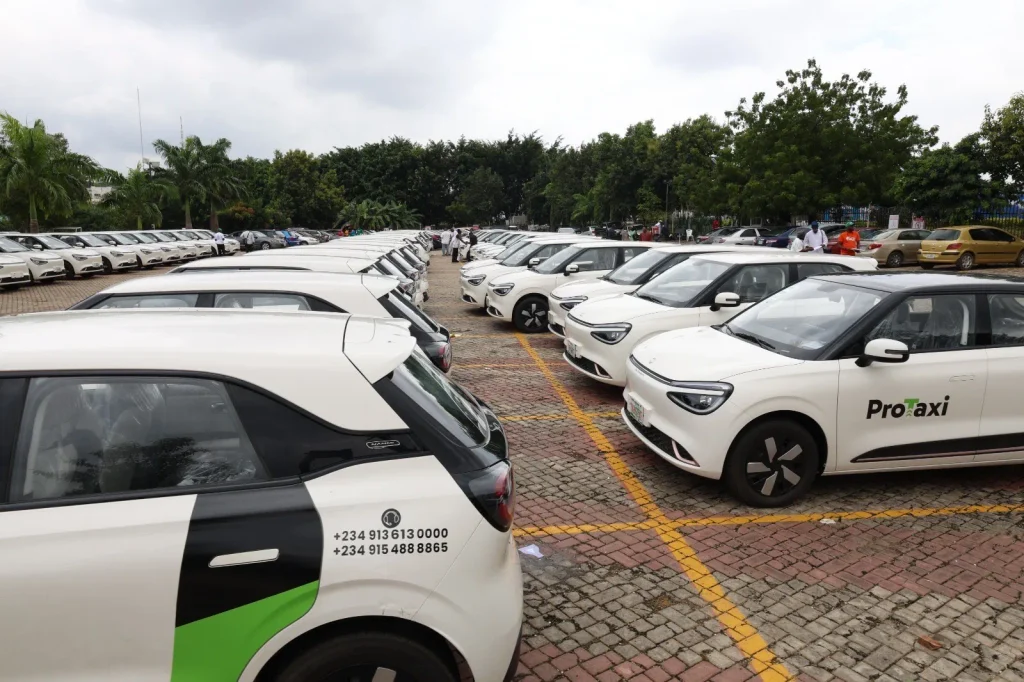
Home-grown e-hailing platform ProTaxi has commenced operations in Abuja, entering the capital’s increasingly competitive mobility market with an electric-vehicle model and a plan to onboard up to 1,000 drivers with EVs.
The platform was officially launched in Abuja on 1 October 2026 by PromiseLand Innovations Limited, positioning electric mobility, lower operating costs and driver income opportunities at the centre of its business model.
For Abuja’s transport and technology market, the launch is significant because it adds another locally built ride-hailing operator to a sector already shaped by international platforms, fuel-price pressure, rising vehicle costs and growing interest in cleaner urban transport.
ProTaxi is entering Abuja with an EV-led e-hailing model and a stated plan to empower up to 1,000 drivers with electric vehicles, creating a new test of whether lower energy costs can support more affordable ride-hailing economics.
ProTaxi begins operations in Abuja
PromiseLand Innovations officially launched ProTaxi in Abuja on 1 October, introducing the service as an electric-powered alternative within Nigeria’s ride-hailing market.
According to Premium Times, the company says the platform is designed to provide affordable urban mobility while creating income opportunities for drivers and their households.
The Abuja launch marks the company’s first operating market, with plans to expand into other Nigerian cities and eventually other African markets.
The 1,000-EV plan is central to the business model
PromiseLand Innovations had earlier announced plans to onboard and empower up to 1,000 drivers with electric vehicles through the ProTaxi initiative.
Some launch reports described the project as a 1,000-EV rollout, while the company’s own earlier statements framed the initiative as a driver-empowerment programme built around supplying vehicles over time.
For that reason, Abuja Business News treats 1,000 vehicles as the company’s announced programme target rather than assuming all 1,000 units are already active on Abuja roads.
Why electric vehicles matter to e-hailing economics
Ride-hailing economics in Nigeria are heavily influenced by fuel, vehicle maintenance, financing costs, depreciation and driver commissions.
Electric vehicles potentially change that cost structure because electricity can be cheaper per kilometre than petrol, while EVs also contain fewer moving mechanical parts than conventional internal-combustion vehicles.
For drivers, the potential benefit is lower day-to-day operating cost. For passengers, the commercial promise is that some of those savings can support more competitive fares.
The real outcome will depend on charging costs, vehicle acquisition or repayment structures, battery performance, utilisation, maintenance support and the reliability of charging infrastructure.
Abuja is becoming an early test market for electric mobility
ProTaxi is not entering an empty EV market.
Abuja already has emerging electric-mobility infrastructure, including NNPC Retail’s smart station on Bill Clinton Drive with a large EV charging component, while other mobility companies have also begun promoting cleaner vehicle technologies.
This makes the capital increasingly relevant as a test environment for electric transport because government institutions, corporate organisations, airport traffic, professional commuters and relatively structured road networks create a broad mix of trip demand.
Charging infrastructure will be critical
An electric ride-hailing service can only scale if charging is available where drivers need it and if charging downtime does not undermine daily earnings.
Important factors include:
- the number and location of charging points;
- charging speed;
- cost per charging session;
- vehicle range under Abuja driving conditions;
- battery reliability and warranty support;
- availability of replacement parts; and
- how drivers manage charging during peak-demand periods.
ProTaxi says its model is built around electric mobility and strategic charging partnerships, but actual operating performance will become clearer as more vehicles enter service.
Driver ownership and financing will shape adoption
One of the most important commercial questions is how drivers gain access to the vehicles.
The company has described the initiative as an empowerment programme intended to create income opportunities for drivers and families, but drivers should evaluate the full commercial terms of any vehicle arrangement before joining.
Relevant questions include:
- whether the vehicle is leased, financed or provided under another arrangement;
- daily or weekly repayment obligations;
- insurance responsibilities;
- maintenance and battery-replacement responsibilities;
- platform commission or service charges;
- minimum trip requirements; and
- the conditions for eventual vehicle ownership, where applicable.
ProTaxi joins a competitive Abuja ride-hailing market
Abuja commuters already have access to multiple app-based and traditional transport options, including established ride-hailing platforms, taxis, corporate car services and newer local mobility companies.
That means ProTaxi will need to compete on more than environmental positioning.
Passengers will ultimately judge the platform on fare levels, driver availability, waiting times, safety, customer support, app reliability and the quality of vehicles.
Drivers will judge it on earnings, cost structure, commission levels, access to vehicles and the predictability of demand.
Technology is part of the proposition
ProTaxi is being presented as a technology-driven e-hailing platform rather than simply an EV fleet.
The service is available through a mobile application, and its Google Play listing positions the platform around ride booking, eco-friendly transport and driver participation.
The company says its wider ambition is to build an African technology company capable of using digital platforms to improve everyday mobility and economic opportunity.
The employment angle is commercially important
Beyond passenger transport, the company is emphasising driver income generation as a core part of the launch.
That gives the model a second commercial dimension: ProTaxi is not only trying to win riders but also to attract and retain drivers by reducing one of the biggest barriers in the sector — access to a reliable vehicle.
If the company can structure vehicle access at a cost drivers can sustain, that could support faster fleet growth. If repayment burdens are too high, however, the economics may become difficult despite lower energy costs.
Policy support could accelerate private EV investment
Federal transportation officials who attended the Abuja launch publicly welcomed greater private-sector participation in electric and alternative-fuel mobility.
That support does not guarantee commercial success for any individual operator, but it signals a policy environment increasingly open to EVs, CNG vehicles and other alternatives to conventional petrol transport.
For investors, the opportunity extends beyond ride-hailing itself into charging infrastructure, fleet financing, battery services, vehicle maintenance, insurance, software, payment systems and fleet management.
What Abuja businesses should watch next
The most important indicators over the next several months will be operational rather than promotional.
Businesses and investors should watch:
- how many EVs are actually deployed and active;
- driver uptake and retention;
- charging-network partnerships;
- fare competitiveness against established platforms;
- vehicle uptime and maintenance performance;
- customer adoption and repeat usage; and
- whether ProTaxi expands beyond Abuja on schedule.
If the model proves commercially sustainable, ProTaxi could become an important case study for how electric mobility, local technology and driver financing can intersect in Nigeria’s urban transport market.
Sources: BusinessDay; Premium Times; The Guardian; Google Play.
Leave a Reply
You must be logged in to post a comment.