
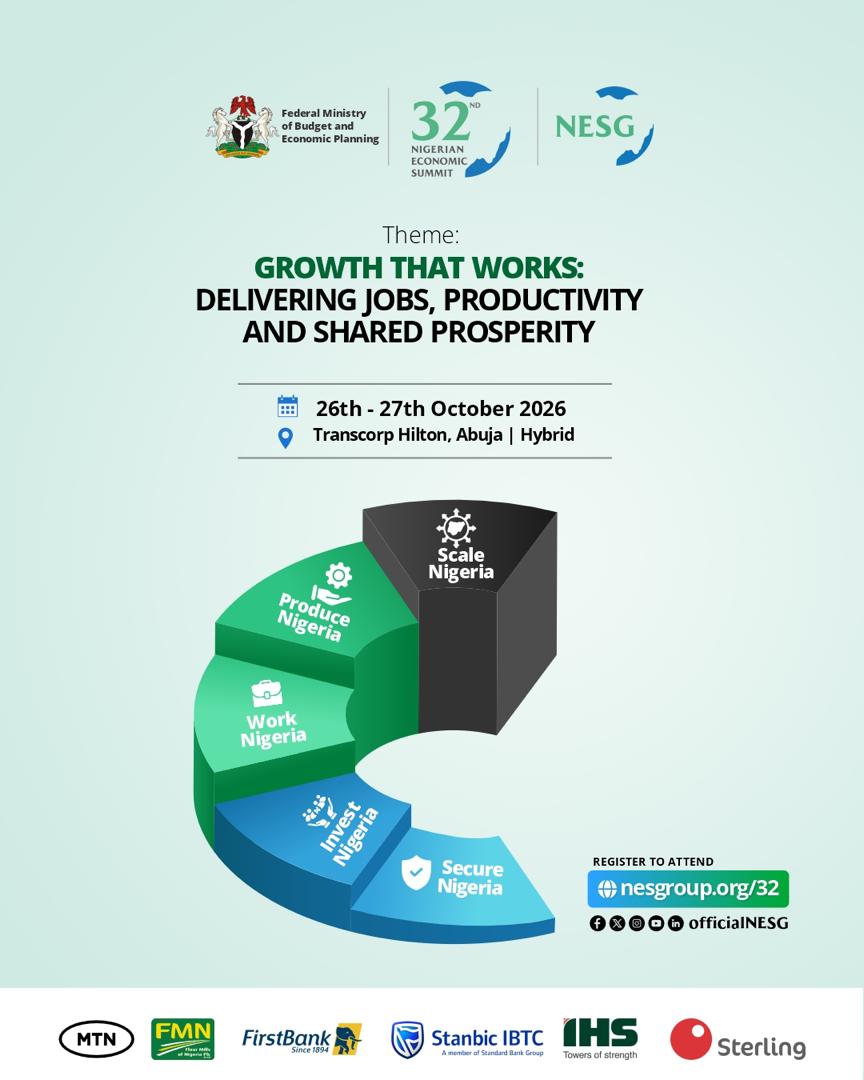
The 32nd Nigerian Economic Summit will bring government, corporate leaders, investors and development institutions to Abuja on 26–27 October 2026, with a programme focused on converting economic reforms into jobs, productive investment and businesses capable of scaling.
The Nigerian Economic Summit Group’s current programme lists Transcorp Hilton Abuja as the venue, with virtual participation also available. The two principal summit days contain 54 sessions, while three registration and community sessions are scheduled for 25 October.
The theme, “Growth That Works: Delivering Jobs, Productivity and Shared Prosperity,” reflects a shift from debating macroeconomic stabilisation to examining whether reforms reduce the cost of production, expand employment and improve the flow of capital to viable enterprises.
Five tracks with direct business implications
NES#32 is organised around five action tracks: Work Nigeria, Produce Nigeria, Invest Nigeria, Secure Nigeria and Scale Nigeria. Together, they place labour absorption, industrial productivity, investment, economic security and growth outside the largest commercial centres on the same agenda.
- Work Nigeria: workforce readiness, labour-intensive growth and the ability of businesses to hire and train at scale.
- Produce Nigeria: lower production costs, stronger infrastructure, industrialisation and domestic value creation.
- Invest Nigeria: productive capital, investment confidence and financing that moves beyond short-term transactions.
- Secure Nigeria: protection of farms, trade corridors, production zones, infrastructure and other commercial assets.
- Scale Nigeria: regional value chains, state-level opportunity and enterprises that can expand beyond one market.
For Abuja companies, the relevance is not limited to the conference venue. The agenda brings together the institutions that shape procurement, tax, finance, infrastructure and sector policy alongside firms that must make investment and hiring decisions under those rules.
What the official agenda shows
The published programme includes sessions on productive capital for Nigerian enterprises, transport and trade infrastructure financing, investment by multinational companies, human-capital competitiveness, housing, subnational growth and the translation of previous summit recommendations into the National Development Plan 2026–2030.
Corporate hosts named on the programme include FirstBank, MTN, Stanbic IBTC Bank, Flour Mills of Nigeria and Sterling Bank. Their involvement signals that the summit will combine policy dialogue with sector-specific discussions led by companies already allocating capital, managing supply chains and serving large customer markets.
The organiser projects more than 2,000 delegates and over 100 speakers. These are event targets rather than guaranteed attendance figures, but they indicate the scale of the network being assembled and the need for participants to prepare specific commercial objectives before registering.
Why the timing matters
At a pre-summit press conference in Abuja, NESG Chief Executive Tayo Adeloju argued that macroeconomic changes will have limited value unless they translate into productive investment, lower operating costs and scalable employment. Fresh reports from The Guardian and BusinessDay highlight infrastructure gaps, expensive production and informality as continuing constraints on firms.
BusinessDay also reported a government statement that recommendations from the previous summit had entered public execution frameworks and supported more than ₦9 trillion in public-private partnership investments. That figure is an official claim reported from the press conference; businesses should assess individual projects through their own financial, legal and procurement due diligence.
The more useful test for NES#32 will therefore be whether its sessions produce named actions, responsible institutions, financing paths and measurable timelines. Policy consensus can improve market confidence, but companies make investment decisions on implementation, contract enforceability and expected returns.
Commercial opportunities around the summit
The event can generate immediate demand in Abuja for accommodation, transport, events, media, professional services and corporate hospitality. It also gives local advisers, technology firms, manufacturers, financiers and project developers a concentrated route to potential partners.
However, attendance is not the same as access to funding or government contracts. Companies seeking capital should bring a concise investment case, verified financial information, a clear use of funds and evidence of market demand. Businesses pursuing partnerships should be ready to explain the commercial problem they solve, the counterparties they need and the milestones that would move a conversation into a transaction.
How Abuja businesses should prepare
- Select the right sessions: map the agenda to a financing, market-access, policy or partnership objective instead of attending every discussion.
- Prepare a one-page commercial brief: include the business model, traction, funding requirement, counterparties and next decision required.
- Identify target institutions: research speakers, corporate hosts and relevant agencies before requesting meetings.
- Define follow-up ownership: assign one person to record commitments, deadlines and contact details immediately after each conversation.
- Check official registration terms: confirm access type, venue logistics and virtual participation directly through the organiser’s registration platform.
Businesses should also distinguish between policy sessions and transaction-ready opportunities. A productive summit outcome may be a regulatory clarification, a referral, an invitation to submit documentation or a follow-up meeting—not necessarily an immediate deal.
What to watch after NES#32
The summit’s value will become clearer after the closing session. Abuja Business News will be watching for published commitments, updates to the National Development Plan, specific private-sector investment announcements, procurement or financing windows, and evidence that earlier recommendations have moved from discussion into execution.
For companies, the practical question is whether NES#32 reduces uncertainty or creates a credible pathway to capital, infrastructure, skills and markets. Those outcomes—not delegate numbers or speeches—will determine its commercial significance.
Related Reads
- Africa Raw Materials Summit Brings Factory Investment and Supply-Chain Agenda to Abuja
- Interswitch Sets Abuja TechConnect for October 13 as Payments Infrastructure Takes Focus
- NUPRC Opens 40 Oil and Gas Blocks as 2026 Licensing Round Starts in Abuja
Leave a Reply
You must be logged in to post a comment.