
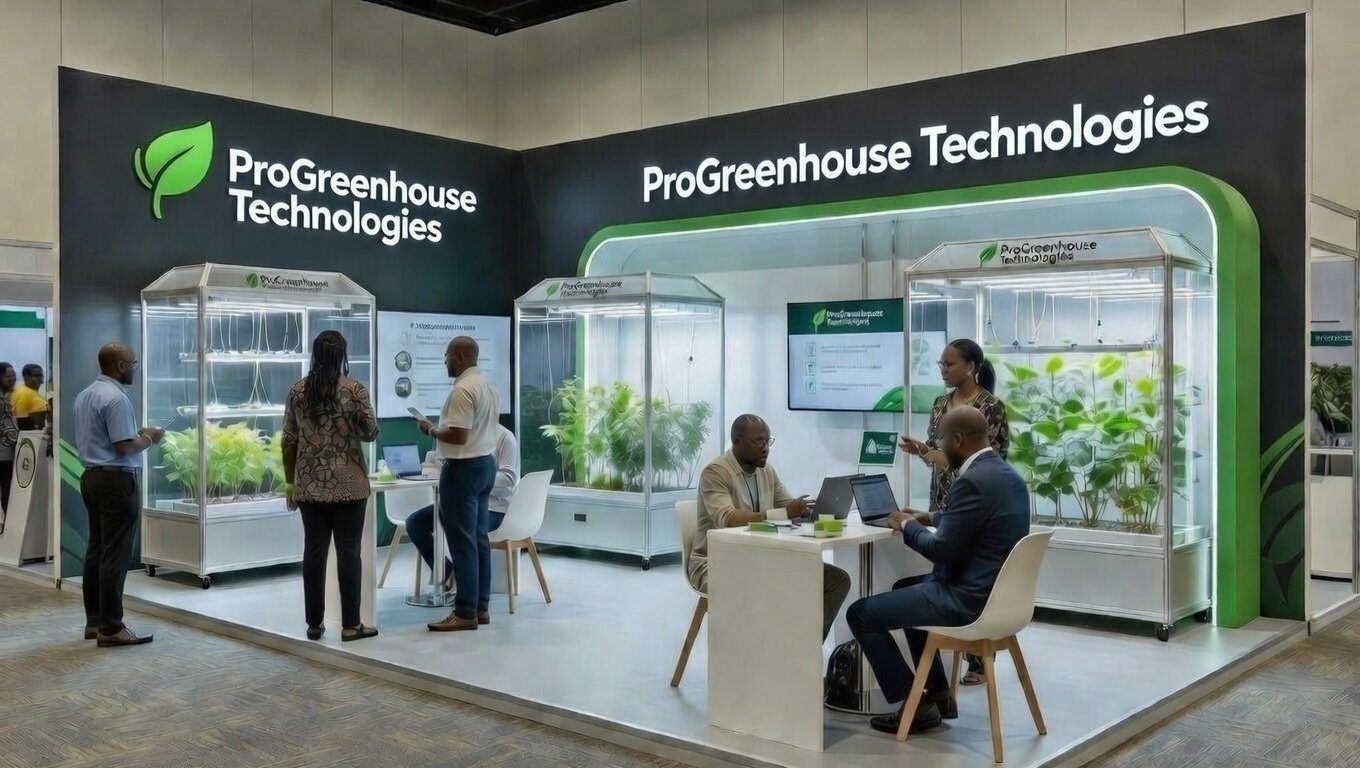
CEA Nigeria 2026 will bring greenhouse, hydroponics, vertical-farming, automation and renewable-energy suppliers to Abuja from 17–19 November, giving agribusinesses, investors and technology providers a focused route into controlled-environment agriculture.
The three-day Controlled Environment Agriculture Expo is scheduled for the Abuja Trade and Convention Centre in Lugbe. The organiser describes it as West Africa’s first exhibition devoted exclusively to smart farming and controlled-environment agriculture, with a commercial focus on technology supply, investment, partnerships and capacity building.
For Abuja’s business community, the event is more than an agricultural showcase. It brings together systems that can affect food production, cold-chain reliability, hospitality procurement, retail supply, energy demand and the economics of year-round farming around the Federal Capital Territory.
What CEA Nigeria is bringing to Abuja
The current organiser listing identifies 17–19 November 2026 as the event dates. An independent Visit Abuja listing, last checked against the organiser in October, confirms the same dates and venue. Eventbrite also lists the expo at the Abuja Trade and Convention Centre under organiser CEMS Tradeshow.
The exhibition profile spans greenhouse structures and climate controls; hydroponic and aeroponic systems; vertical farms; sensors and farm-management software; automated irrigation and fertigation; LED grow lighting; and solar or hybrid power for agricultural operations.
That mix matters because controlled-environment agriculture is not a single product. A commercially viable project usually combines structure, water treatment, growing systems, energy, cooling, monitoring, crop expertise, maintenance and a dependable route to market. An expo that places several parts of that supply chain in one venue can shorten the process of comparing vendors and building partnerships—but it does not remove the need for technical and financial due diligence.
Where the business opportunities are
Abuja has a large institutional and consumer food market, including hotels, restaurants, supermarkets, caterers, schools, hospitals and government facilities. Farms capable of supplying consistent quality throughout the year may find opportunities in that demand, especially for leafy vegetables, herbs, seedlings and other higher-value crops that fit controlled systems.
The opportunity set extends beyond growers:
- Technology distributors can assess greenhouse kits, pumps, sensors, controllers, dosing systems, lighting and water-management equipment for local representation.
- Engineering and energy firms can pursue installation, automation, solar integration, backup power, cooling and maintenance contracts.
- Property owners and developers can explore rooftop, warehouse, peri-urban and modular production models, subject to planning, load, water and safety requirements.
- Food buyers can meet producers and technology-backed farm operators seeking offtake arrangements.
- Investors and lenders can examine projects whose returns depend on yield, crop prices, power costs, operating discipline and contracted demand.
- Agritech startups can test monitoring, marketplace, traceability, farm-finance and logistics products with potential customers and partners.
Why economics matter more than the technology pitch
Controlled systems can improve consistency and reduce exposure to some weather risks, but they can also carry substantial capital and operating costs. Power, cooling, imported components, nutrients, skilled labour, spare parts and crop management can determine whether a technically impressive installation becomes a profitable business.
Buyers should ask suppliers for crop-specific performance data, itemised capital costs, expected energy and water consumption, local maintenance capacity, warranty terms and a realistic replacement-parts plan. Yield projections should be tested against Abuja market prices and likely rejection or spoilage rates rather than accepted at face value.
Businesses should also distinguish between demonstration-scale systems and commercial farms. A small hydroponic unit that works well for training or household production does not automatically prove the economics of a larger project. Scale changes the requirements for water quality, disease control, labour, cooling, packaging and sales.
Practical checklist for visitors
Companies attending with a purchase or partnership in mind should arrive with a short specification: proposed site, available space, crops, target buyers, budget range, power supply, water source and expected production volume. That makes it easier to compare like-for-like proposals and identify vendors whose systems fit local conditions.
Before signing a supply agreement or paying a deposit, businesses should:
- request a written bill of quantities and operating-cost estimate;
- verify the vendor’s Nigerian references and after-sales capacity;
- confirm the source and delivery time for consumables and spare parts;
- test the assumptions behind yield, selling price and payback period;
- clarify training, warranty, commissioning and performance obligations; and
- check land-use, water, electrical and food-safety requirements relevant to the project.
Event details and verification note
Event: CEA Nigeria 2026 — Controlled Environment Agriculture Expo
Dates: 17–19 November 2026
Venue: Abuja Trade and Convention Centre, KM 8 Umaru Musa Yar’Adua Road, Lugbe, Abuja
Audience: Agribusinesses, commercial farmers, technology suppliers, investors, researchers and policymakers
The organiser’s current homepage and the independent Visit Abuja listing agree on the November dates. Some older manual pages on the organiser’s website still contain obsolete August references, so visitors should use the current homepage and registration channel and reconfirm opening hours before travelling.
Related Reads
- AGROMEQA Expo Brings Agritech Investment and Export Focus to Abuja
- Giri Agro-Processing Hub Seeks $105m as Abuja Joins Federal Investment Pipeline
- DBN Launches $275m Climate Finance Programme; Abuja SMEs Can Apply
Leave a Reply
You must be logged in to post a comment.