
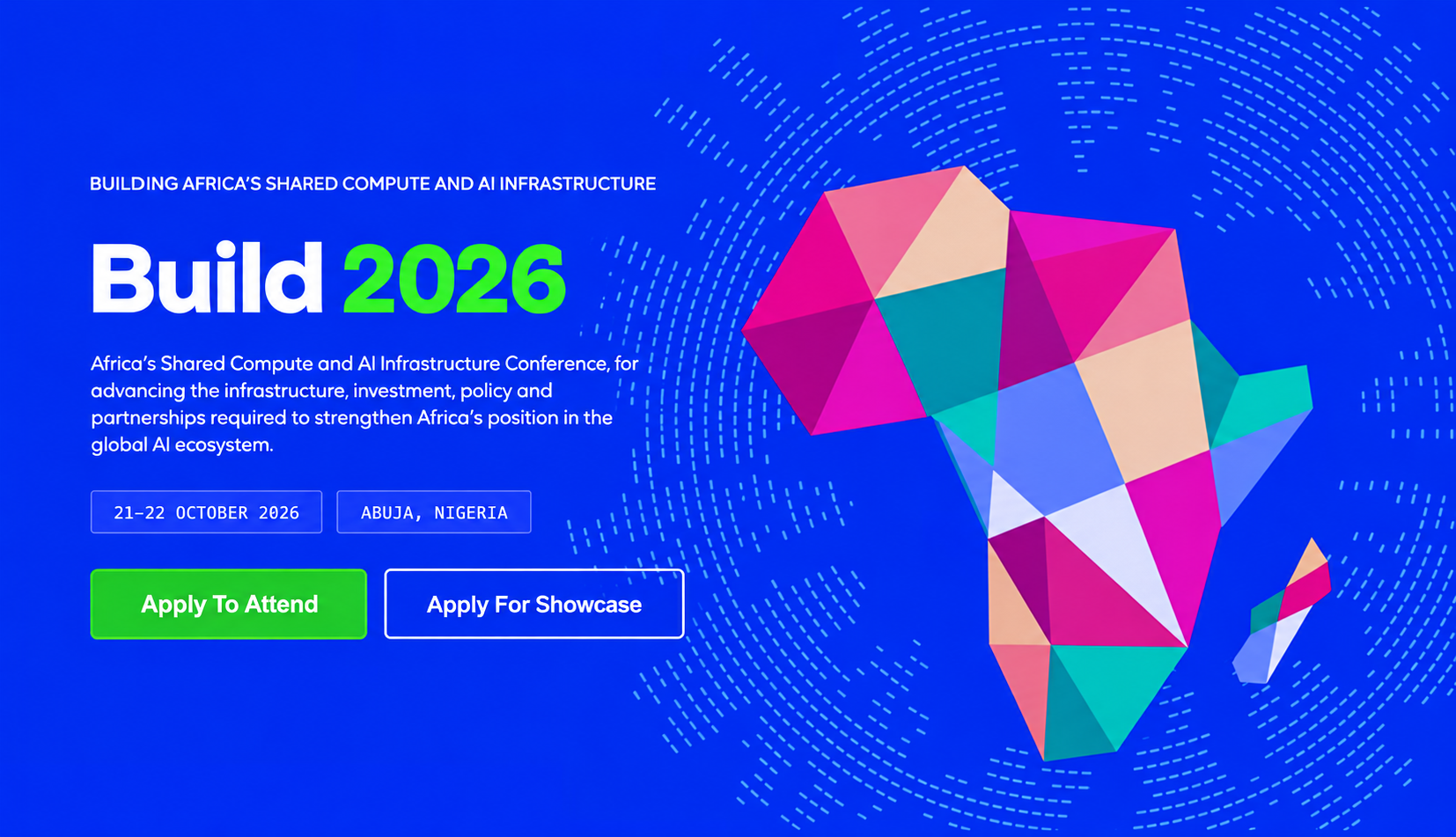
BUILD 2026 will bring policymakers, investors, infrastructure providers, researchers and technology founders to Abuja on 21–22 October, with applications closing this week for attendance and for startups seeking a place in the event’s Innovation Expo.
Abuja to host Africa’s shared-compute conversation
The Nigeria AI Collective has opened applications for BUILD 2026, a two-day conference focused on the infrastructure, investment, policy and partnerships needed to expand artificial-intelligence capacity across Africa.
The event is scheduled for 21–22 October 2026 in Abuja and is being convened under the leadership of the Federal Ministry of Communications, Innovation and Digital Economy. Its six programme tracks cover infrastructure, economics, digital sovereignty, governance and ethics, technology justice, and innovation catalysis.
Organisers say attendance applications close on Thursday, 8 October. A separate Innovation Expo call for startups, product teams, researchers and independent builders closes on Wednesday, 7 October. Spaces are limited and applications will be reviewed.
The business case goes beyond another technology conference
The commercial issue at the centre of BUILD 2026 is access to the computing capacity that modern AI products require. Reliable power, high-performance computing, data centres, cloud infrastructure, fibre connectivity and workable procurement models all influence whether African companies can build locally, control costs and scale competitive products.
For Abuja’s technology ecosystem, that creates a practical meeting point for several groups: startups seeking compute and customers; telecoms and data-centre operators looking for demand; energy companies serving digital infrastructure; investors assessing capital-intensive platforms; and public institutions shaping policy, standards and procurement.
The official programme includes executive roundtables, technical workshops, an investment and partnership forum, research-to-innovation sessions and an exhibition of AI products and prototypes. The stated ambition is to move the discussion from policy language to investment models, partnerships and infrastructure projects.
What the Innovation Expo offers founders
The Innovation Expo is open to African AI startups, product companies, developer teams, research spin-offs, students and early-stage founders. Applicants must have more than an idea: the organisers require a demonstrable product, prototype, minimum viable product or proof of concept.
Selected teams may be invited to pitch on the main stage, demonstrate at the BUILD AI Garage, compete for cash prizes and compute-support opportunities, and meet investors, buyers, corporate innovation teams, government agencies and development organisations. The programme does not promise that every selected applicant will receive funding or compute; businesses should treat those outcomes as competitive opportunities rather than guaranteed benefits.
What Abuja businesses should prepare
- A concise product case: explain the business problem, where AI is essential and why the solution is defensible.
- Evidence of execution: prepare a working demo, prototype screenshots, pilot results, customer feedback or other proof that the product has moved beyond concept stage.
- Traction and market data: state who uses the product, the target market, revenue or adoption signals, and the next milestone.
- Infrastructure requirements: quantify current and projected needs for cloud credits, graphics-processing capacity, storage, bandwidth, power and data access.
- A specific partnership request: decide whether the priority is investment, compute access, a pilot customer, technical integration, regulatory guidance or distribution.
Infrastructure providers and professional-services firms should also prepare clear offers. Abuja-based operators in connectivity, cybersecurity, power, cloud migration, legal compliance and enterprise sales can use the event to position themselves as enabling partners rather than spectators.
Why Abuja matters
Hosting the conference in the capital places private-sector discussions close to the ministries, regulators, diplomatic missions and development institutions that influence large infrastructure decisions. That proximity is valuable, but the real business test will be whether the event produces investable projects, usable procurement pathways, affordable compute arrangements and customer introductions for companies already building.
Applications should be submitted only through the organisers’ official pages. Businesses should review the criteria, avoid unsupported claims about traction, and keep a record of submitted materials and deadlines.
Related Reads
- Abuja Named Cybersecurity Cluster as NICE Opens Innovation Pipeline Clinics to Businesses
- NCC Pushes for Bigger Digital Infrastructure Investment as Abuja Hosts Nigeria Connectivity Forum
- SMFEST Abuja 2026 Sets October Dates for Founders, Creators and Digital Businesses
Leave a Reply
You must be logged in to post a comment.