
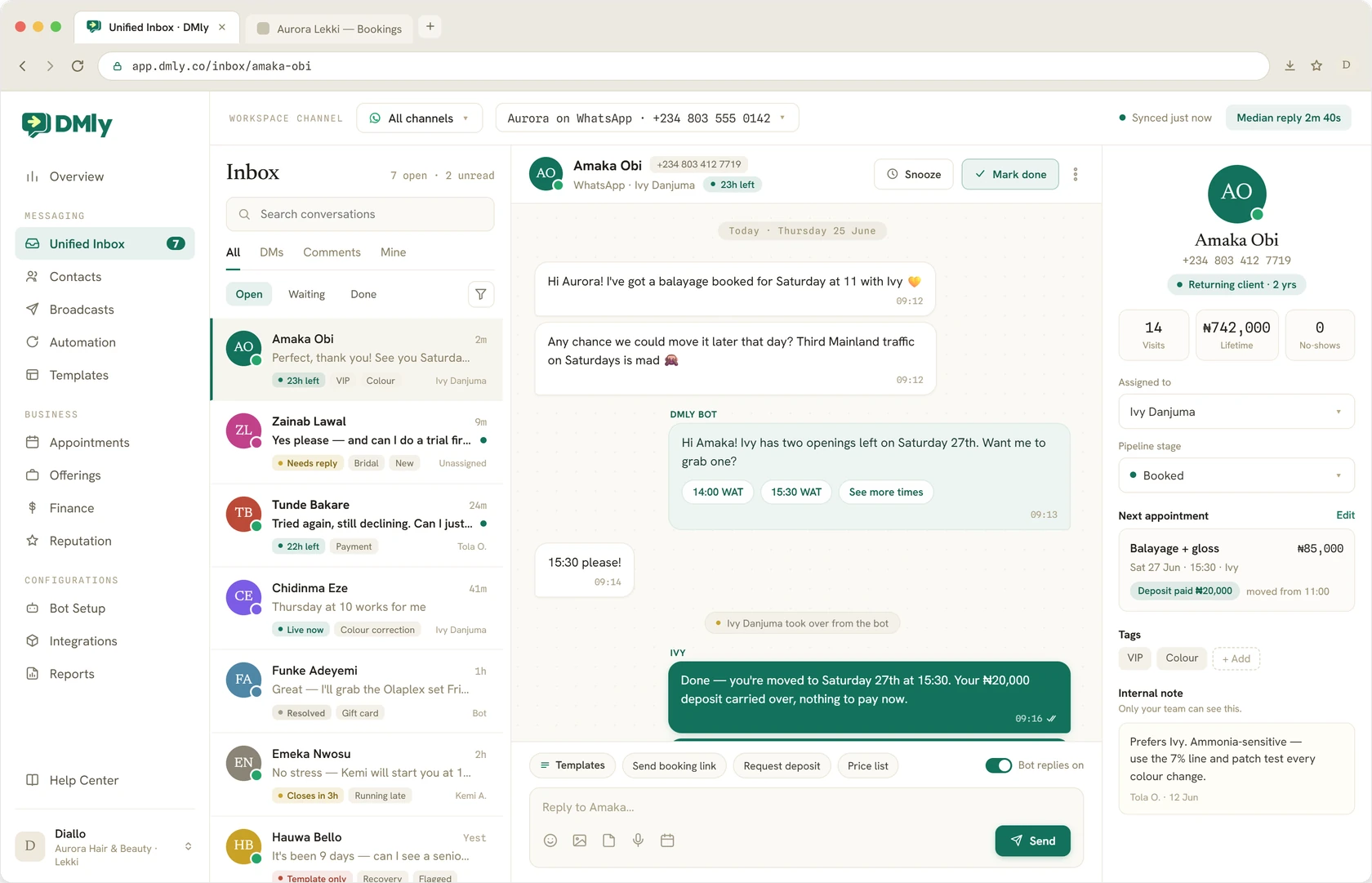

DMly has launched a Nigeria-focused customer-management platform from an Abuja contact office, targeting small businesses that convert WhatsApp and Instagram conversations into bookings and payments—but merchants still need to assess Meta charges, data handling and the economics of another monthly software subscription.
The platform combines customer messages, automated replies, appointment scheduling, invoices, payment links and follow-up tools in one interface. DMly’s Nigeria page lists an office at Novare Central Mall in Wuse Zone 5, while the company says the product is operated by United States-registered Client Path, LLC.
Independent reported the Nigerian launch on 2 November 2026 and identified service businesses, retailers and other enterprises that sell through WhatsApp and Instagram as the initial market. The product is not a bank or payment processor: its website says naira payments are routed through integrations including Paystack and Flutterwave.
What the platform offers
DMly’s core proposition is a shared inbox that lets staff see customer conversations across WhatsApp, Instagram, Facebook Messenger and other supported channels. Businesses can configure an AI-assisted agent with their services, prices, opening hours and availability, while staff retain the ability to take over a conversation.
For appointment-led businesses, the system supports bookings, reminders and deposits. Retailers and other merchants can issue invoices and payment links from the same customer thread. The company also promotes comment-to-message automation, team assignment, review requests and broadcasts to customers who have consented to receive marketing messages.
The official Nigeria page currently lists monthly plans of ₦29,000, ₦59,000 and ₦99,000, with a seven-day trial. It also states that Meta’s messaging charges are separate from the DMly subscription. Those figures are vendor prices and may change; businesses should confirm the plan limits, taxes and third-party charges before subscribing.
Why the Abuja launch matters for SMEs
For many Abuja salons, clinics, restaurants, fitness studios, property agents and online retailers, the sale begins in a direct message rather than on a conventional website. A unified inbox can reduce missed enquiries when several employees share responsibility for customer service, while booking and deposit tools may help service businesses limit no-shows.
The local office gives DMly a physical market-entry point for demonstrations, setup support and merchant acquisition in the capital. It also places the company in a competitive business-software market that already includes standalone customer-relationship systems, appointment tools, payment links and Meta’s own business products.
The commercial test will be whether the platform saves enough staff time or captures enough additional sales to justify the recurring subscription and messaging costs. The company has not disclosed Nigerian customer numbers, launch revenue, local staffing, external funding or transaction volumes, so the scale of its Nigerian operation cannot yet be independently assessed.
What businesses should verify before signing up
- Total cost: the subscription, Meta conversation or template charges, payment-processing fees, taxes and any implementation costs.
- Channel access: which WhatsApp, Instagram and other features are included in the selected plan and what requires Meta business verification.
- Data protection: where customer data is stored, how consent and retention are managed, and whether the setup meets Nigeria Data Protection Act obligations.
- Control and portability: whether conversation records, contacts, appointment data and automation flows can be exported if the business leaves the service.
- AI safeguards: how inaccurate automated replies are prevented, when human handover occurs and who is responsible for customer-facing errors.
- Payment reconciliation: settlement timing, refunds, chargebacks and the division of responsibility between DMly and the connected payment processor.
A short pilot with measurable targets—response time, conversion rate, no-show rate and revenue recovered from previously missed enquiries—would give a merchant better evidence than relying on feature lists alone.
Related Reads
- GIGM Expands hireX and PASS to Abuja Corporate Travel Market
- AFRIDATA Unveils $650m–$1bn Nigeria Data Centre Plan at Abuja Launch
- AfroTechXcel Plans Lugbe, Mpape AI Hubs After Training 772 FCT Girls
Sources
- DMly Nigeria: official product features, pricing, payment integrations and Abuja contact office
- DMly: official company and product ownership information
- Independent: report on the Nigeria launch, target merchants and product positioning
- Google Play: DMly mobile application listing and product functions
Leave a Reply
You must be logged in to post a comment.