
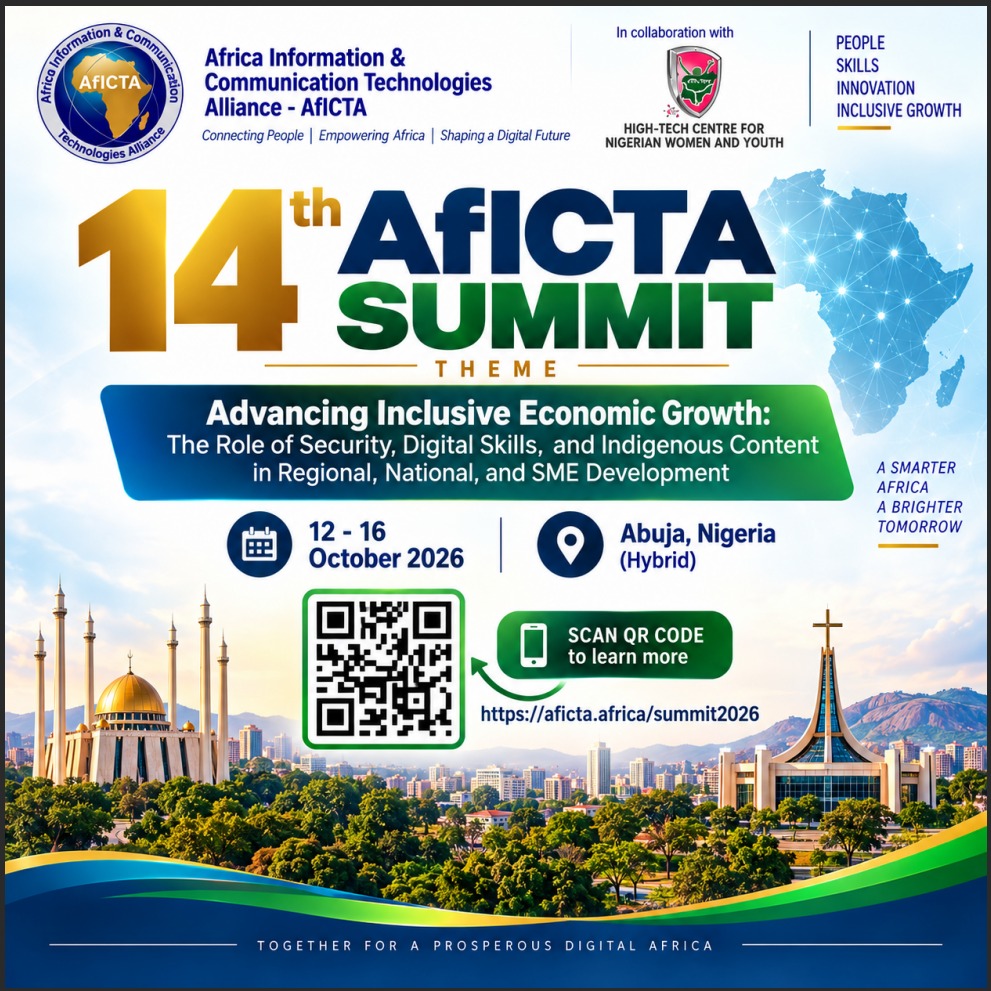
The 14th AfICTA Summit will bring technology companies, policymakers, development partners and SME-support organisations to Abuja for a commercially relevant discussion on cybersecurity, digital skills, indigenous technology and enterprise growth.
AfICTA’s current summit listing schedules the main hybrid programme for 13–14 October 2026 at the Auditorium of the Raw Materials Research and Development Council in Maitama. The organisation’s dedicated event page uses a broader 12–14 October frame, covering arrival and exhibition activity, while the published programme places the principal conference sessions on Tuesday and Wednesday.
The theme is “Advancing Inclusive Economic Growth: The Role of Security, Digital Skills, and Indigenous Content in Regional and National SME Development.” For Abuja businesses, that framing moves the summit beyond a policy conference: it connects operating risks, workforce capability and demand for locally developed technology to the practical question of how smaller firms can compete and scale.
What is on the commercial agenda
The published programme includes sessions on securing digital infrastructure, building home-grown technology and manufacturing capacity, data protection, financial and market access for SMEs, and expanding women’s participation in technology companies. It also lists discussions involving institutions and industry groups such as NITDA, NCC, NDPC, SMEDAN, NASME and NACCIMA.
These themes matter to companies operating in Abuja because digital adoption increasingly carries compliance and procurement consequences. A business offering software, cloud services, payments, professional services or outsourced operations may need to demonstrate stronger data-handling controls, clearer local value creation and a workforce capable of supporting institutional clients.
AfICTA’s event page also advertises commercial participation packages. The published prices include US$250 for a logo or a short opening-ceremony speaking opportunity, US$500 for a 30-minute thematic product or service session and US$1,000 for exhibition space. These are organiser-listed promotional packages, not investment commitments or guaranteed sales; interested companies should confirm availability and deliverables directly with AfICTA before paying.
Masterclasses target public-sector digital demand
The summit page lists three ₦290,000 masterclasses aimed at state and subnational officials. The subjects cover digital-economy policy for job and wealth creation, compliance with Nigeria’s data-protection framework, and the use of artificial intelligence in public administration.
For private technology vendors and consultants, the significance is not the course fee alone. The topics indicate where public-sector demand may develop: cybersecurity audits, privacy governance, AI implementation, staff training, local-content solutions and digital-service modernisation. Companies that want to sell into this market will still need to follow formal procurement processes and prove capability; conference participation does not substitute for tender qualification.
How Abuja SMEs can prepare
- Define one business objective. Decide whether the priority is finding customers, meeting regulators, identifying partners or understanding a compliance requirement.
- Prepare a short capability statement. Explain the problem your company solves, the sectors served, evidence of delivery and the specific partnership or contract sought.
- Review data and cybersecurity controls. Be ready to discuss how customer information is collected, stored, accessed and protected.
- Map relevant sessions and institutions. Prioritise the programme areas closest to your product instead of treating the summit as a general networking event.
- Verify participation terms. Confirm the current schedule, registration, package deliverables and payment route with the organiser because the official pages use slightly different overall date ranges.
Why the summit matters for Abuja
Hosting the programme in Maitama gives local technology firms direct access to a cross-section of regulators, public agencies, trade groups and potential enterprise buyers. It also reinforces Abuja’s role as a market where technology companies often sell not only to consumers, but to government bodies, development organisations and businesses operating in regulated sectors.
The real test will come after the summit: whether introductions lead to procurement opportunities, skills programmes, stronger compliance practices or partnerships that include smaller local suppliers. Businesses should therefore judge participation by documented follow-up rather than attendance numbers alone.
Related Reads
- NITDA Sets ₦3bn Startup Deal Pipeline for Abuja Builders Festival
- Canada-Backed TRISEG Targets Export Support for 200 Nigerian SMEs
- Africa Climate Forum Opens Abuja Deal Room for Green Projects and Investors
Leave a Reply
You must be logged in to post a comment.