
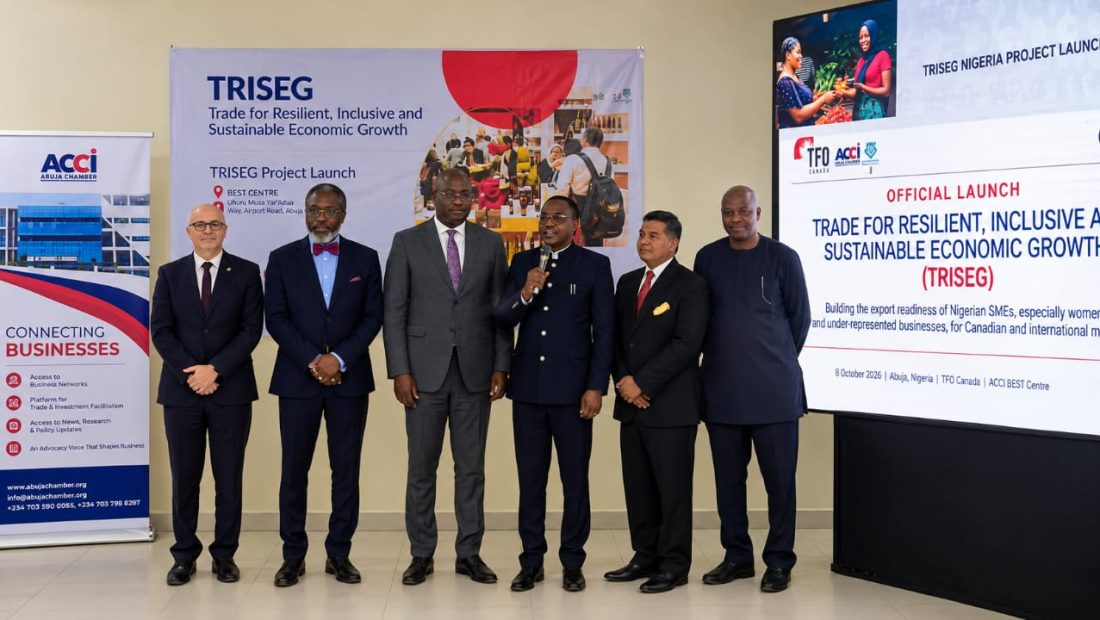
A five-year Canada-funded export programme launched in Abuja will target 200 Nigerian small and medium-sized businesses, combining market intelligence, business coaching, digital support and connections to international buyers, with 67 per cent of the Nigerian cohort intended for women-led and other under-represented enterprises.
The Trade for Resilient, Inclusive and Sustainable Economic Growth programme, known as TRISEG, was formally launched in Nigeria on 8 October by the Federal Government, the Abuja Chamber of Commerce and Industry and Trade Facilitation Office Canada. Global Affairs Canada is funding the initiative, while TFO Canada is implementing it with trade-support institutions across 16 countries between 2025 and 2030.
The Nigerian programme is designed to improve export readiness rather than provide unrestricted cash to every participant. Organisers describe support covering market intelligence, business coaching, export development, digital strategies and connections with Canadian and other international buyers. The launch also included a validation workshop examining Nigeria’s export market and the capacity of institutions that support businesses.
What the 200-SME target means
The target gives the programme a measurable Nigerian cohort, but it should not be read as a guarantee that 200 grants will be issued. TFO Canada’s wider programme aims to support 3,200 SMEs across Africa, Asia, Latin America and the Caribbean, including 2,133 businesses owned or led by women and other under-represented groups. Its online trade-information services are expected to reach more than 5,550 beneficiaries across the participating countries.
TRISEG also includes an SME Climate Resilience Fund. The programme information says the fund will support technical assistance, digital resources, training and the development of climate-resilience investment plans for selected enterprises. That is materially different from general working capital, equipment finance or a conventional business loan, and applicants should wait for published Nigerian eligibility rules before treating any support as available.
Why the Abuja launch matters for exporters
For Abuja-based manufacturers, agribusinesses, consumer brands and business-service companies, the commercial value will depend on whether institutional support produces practical market entry outcomes: compliant products, credible export documentation, buyer introductions and repeatable routes into foreign markets.
The launch identified familiar constraints facing Nigerian exporters, including finance, certification, testing capacity, logistics, digital infrastructure and access to reliable market information. These gaps matter because an overseas buyer introduction is only useful when a supplier can meet product standards, deliver consistent volumes, price competitively and complete the documentation required by the destination market.
The 67 per cent inclusion target may improve access for women-led businesses that have historically faced disproportionate financing and market-entry barriers. Its real impact, however, will be judged by transparent selection, the quality of technical assistance, buyer engagement and evidence of exports or investment secured after participation.
What interested SMEs should prepare
- Company file: registration documents, ownership information, tax records and a concise business profile.
- Export case: target product, production capacity, pricing, existing sales, priority markets and the specific constraint the programme could help remove.
- Compliance evidence: licences, product testing, certifications, labelling, packaging and traceability records relevant to the sector.
- Commercial proof: customer references, purchase orders, distributor discussions or evidence of domestic demand.
- Climate plan: current energy, water, waste and supply-chain risks, plus realistic improvements that technical assistance could support.
No public Nigerian application window, application portal or final selection timetable was identified in the launch materials reviewed by Abuja Business News. SMEs should therefore monitor official notices from ACCI and TFO Canada and avoid paying intermediaries who claim to guarantee selection.
How success should be measured
Training attendance will be an incomplete measure. Stronger indicators would include businesses completing recognised certification, obtaining buyer-ready documentation, entering verified distributor or procurement discussions, securing finance for export orders and recording repeat cross-border sales. Publishing those results would also help other SME-support programmes distinguish activity from commercial impact.
Related Reads
- cyPHER Programme Targets Abuja Women-Led Micro Businesses
- NPA Moves Export Processing Inland: What Abuja Businesses Need to Know
- NITDA Sets ₦3bn Startup Deal Pipeline for Abuja Builders Festival
Leave a Reply
You must be logged in to post a comment.