
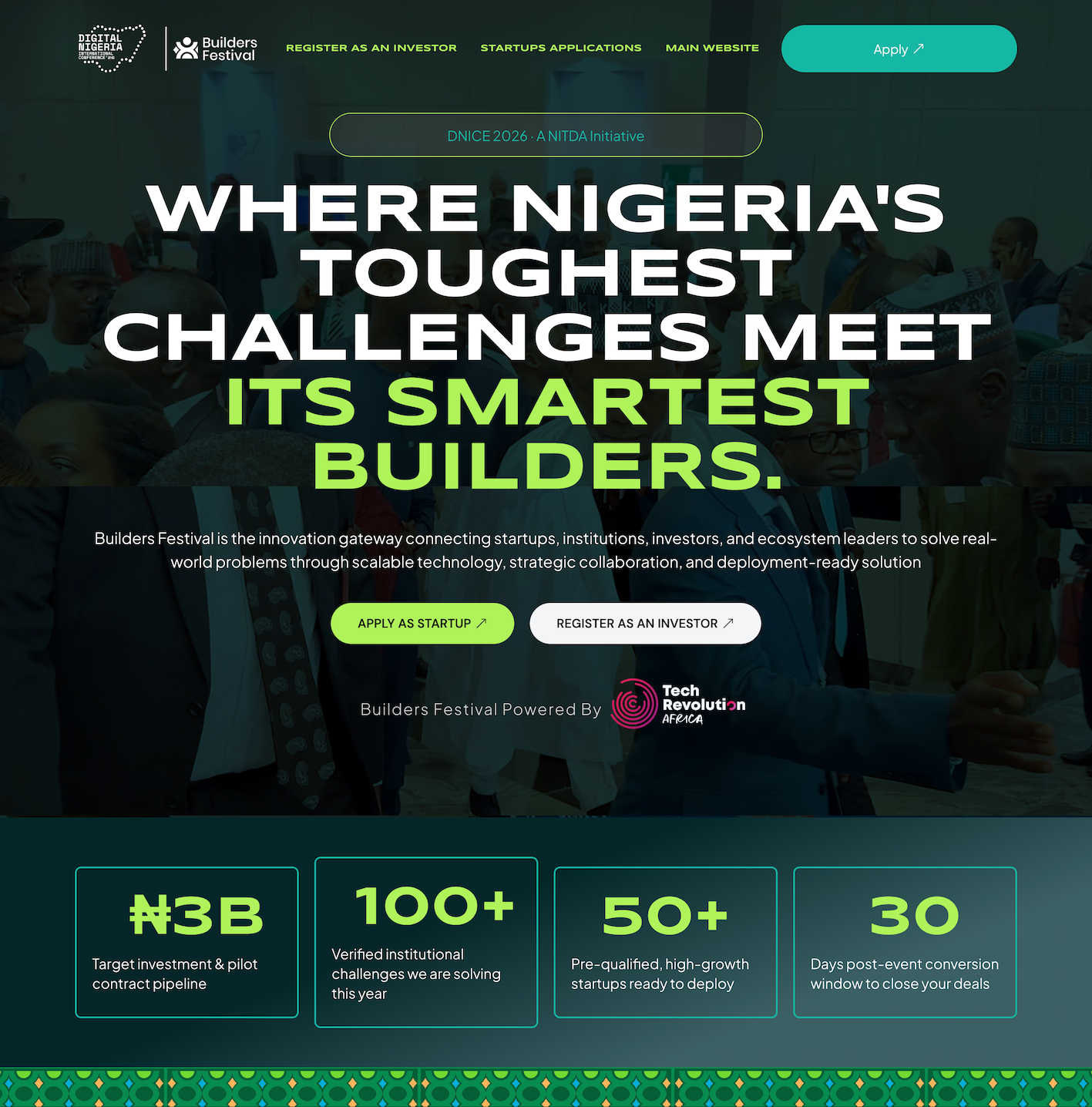
NITDA’s DNICE 2026 Builders Festival is targeting a ₦3 billion investment and pilot-contract pipeline in Abuja, using institutional problem-matching and Deal Room negotiations to connect deployment-ready Nigerian startups with corporate buyers, government agencies and investors.
The Builders Festival is scheduled to culminate during Digital Nigeria International Conference and Exhibition 2026 from 10–12 November at the BAT International Conference Centre in Abuja. The programme is being presented as a National Information Technology Development Agency initiative, with Tech Revolution Africa involved in delivery.
Its commercial proposition is more specific than a conventional startup pitch contest. Participating institutions submit operational problems; programme managers screen and match startups whose products can address those needs; and selected companies enter a Deal Room intended for pilot, investment and memorandum-of-understanding discussions.
A route from enterprise problem to pilot
The official Builders Festival portal says the pipeline covers more than 50 verified institutional challenges and aims to give investors access to pre-qualified Nigerian technology companies. Its startup page lists problems spanning digital identity, customs risk profiling, cargo monitoring, satellite connectivity, SME finance and supply-chain visibility, cross-border payments, patient identity, vaccine logistics and smart infrastructure.
For Abuja’s business ecosystem, the model matters because it puts potential customers—not only judges—into the selection process. A startup that can show a working product, measurable traction, secure integrations and the ability to support a national-scale deployment may have a more credible path to revenue than one relying on a general showcase.
The programme also gives institutions a structured way to test local technology against defined procurement and service-delivery gaps. That could shorten discovery work, but it does not replace vendor due diligence, information-security review, procurement rules, commercial negotiation or implementation testing.
Who the programme is seeking
The current startup application page says applicants should be Nigerian-registered companies at minimum viable product stage or beyond, with at least one live user, active pilot or paying customer. Assessors are expected to look at market traction, team resilience and product maturity rather than idea-stage concepts.
Applications ask founders to identify the institutional challenge they solve, describe their product and integration capability, disclose market traction and pilot history, and state whether they seek equity investment, pilot contracts or both. Those requirements suggest that technical readiness and procurement evidence will carry more weight than presentation polish alone.
What the ₦3 billion figure means
The ₦3 billion number is an organiser-set target for a combined investment and pilot-contract pipeline. It is not a confirmed funding pool, an appropriation or a guarantee that selected startups will receive capital or contracts.
The Guardian independently reported the target on 8 October, describing a plan to connect startups with investors and institutions through defined challenge statements. The commercial outcome will ultimately depend on the quality of matches, buyer budgets, investment terms, regulatory checks and whether pilot discussions convert into signed, funded work.
Deadline discrepancy requires confirmation
Applicants should verify the closing date directly before submitting. As checked on 10 October, the main Builders Festival page states Friday, 16 October 2026, while prominent notices on the startup application page state Monday, 12 October 2026. A lower section of that same page still displays an expired 5 October date. Because the official pages are inconsistent, founders should treat 12 October as the safer operational deadline and seek written confirmation from the organisers.
Practical implications for founders and investors
- Founders: prepare a concise problem-to-product case, proof of live use, security and integration documentation, pilot pricing, deployment timeline and references from existing customers.
- Institutional buyers: define the operational bottleneck, decision owner, budget route, data requirements and measurable pilot outcome before entering the Deal Room.
- Investors: separate pipeline publicity from investible evidence by checking cap tables, revenue quality, customer concentration, regulatory exposure and the conversion terms of any proposed pilot.
- Service providers: legal, cloud, cybersecurity, payments and systems-integration firms may find partnership opportunities around startups that need to become enterprise-ready quickly.
If the matching process produces real pilots, the Abuja event could become a useful test of whether Nigeria’s public and corporate innovation programmes can move beyond demonstrations into contracted deployment. The relevant measure will not be attendance or pitch volume, but the value of pilots funded, integrations completed and commercial agreements still active after the conference.
Related Reads
- Startup Village Nigeria 3.0 Brings Web3 Build Sprint and Demo Day to Abuja
- BUILD 2026 Brings AI Startups, Infrastructure and Investors to Abuja
- Interswitch Sets Abuja TechConnect for October 13 as Payments Infrastructure Takes Focus
Leave a Reply
You must be logged in to post a comment.