
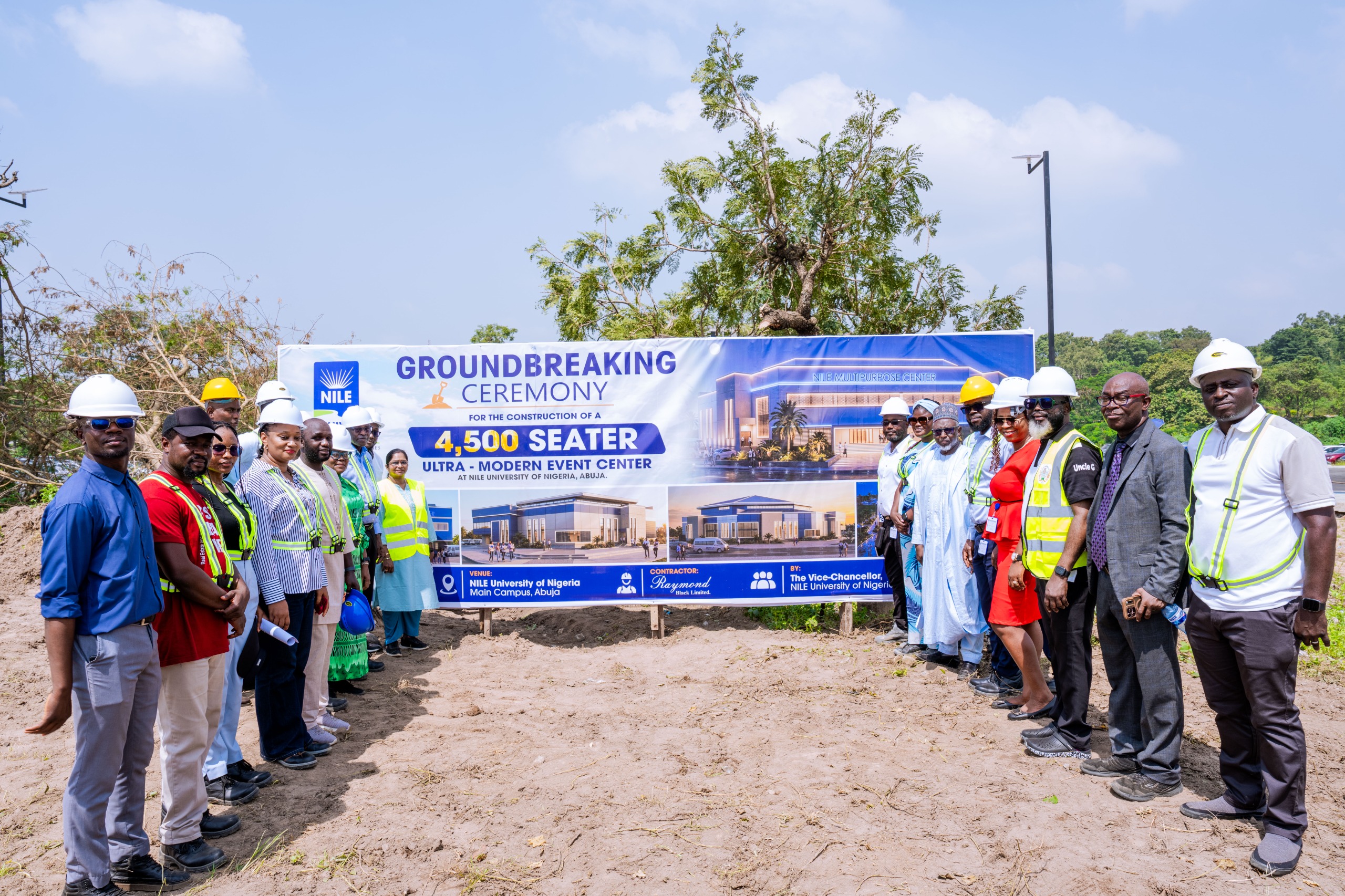
Nile University of Nigeria has started two major campus projects in Abuja: a 4,500-seat multipurpose hall designed for convocations, conferences, exhibitions and international summits, alongside staff housing comprising 65 residential units. The expansion adds new event, retail and residential capacity to the capital’s private-education economy, although the university has not disclosed the investment value, contractor, financing structure or delivery timetable.
The university announced the groundbreaking on 21 October 2026 at its campus near the Jabi Airport Bypass. The hall is planned as more than a ceremonial auditorium, with smaller conference rooms, indoor sporting facilities and retail spaces intended to support academic, professional and social activity.
For Abuja’s business market, the development matters because a 4,500-seat venue would add sizeable capacity for conferences, research exhibitions, professional gatherings and institutional events. The accompanying staff quarters also represent a separate residential investment aimed at supporting workforce stability as the university grows.
What Nile University is building
| Project component | Disclosed specification | Business relevance |
|---|---|---|
| Main auditorium | 4,500 seats | Adds large-event capacity for convocations, conferences and summits |
| Supporting rooms | Mini-conference rooms | Creates space for executive meetings, workshops and smaller professional sessions |
| Commercial areas | Retail spaces | Could support food, convenience and service operators, subject to the university’s tenancy model |
| Recreation | Indoor sporting facilities | Broadens campus amenities and potential event programming |
| Staff housing | 65 residential units | Adds accommodation tied to institutional workforce growth |
The official announcement says the main facility will host conferences, research exhibitions, social events and international summits, bringing together students, academics, researchers and industry professionals. That mix gives the project a potential role in Abuja’s knowledge, events and professional-services economy, in addition to its primary university function.
A campus project with an events-market angle
Abuja already has a concentrated market for government, diplomatic, corporate and association events. A university-based venue of this scale could widen the city’s event inventory, particularly for gatherings that combine academic content, exhibitions and industry participation.
The commercial opportunity will depend on how the completed hall is operated. Nile University has not said whether external organisations will be able to book the venue, how frequently non-academic events will be accepted, or whether retail units will be leased to independent operators. Those details will determine whether the project functions mainly as institutional infrastructure or also competes in Abuja’s wider conference and venue market.
Its location near the Jabi Airport Bypass could support access from central Abuja and the airport corridor, but large-event performance will also depend on parking, traffic management, power resilience, security, internet capacity, acoustics and transport coordination. These operating factors often decide whether a large auditorium becomes a consistently used commercial asset or remains active only for periodic ceremonies.
Staff housing adds a second property dimension
The 65-unit staff-quarters project signals that the expansion is not confined to event space. Employer-supported housing can help an institution reduce commuting pressure, improve staff retention and support longer-term campus planning, particularly in a city where accommodation and transport costs affect workforce decisions.
It also creates a separate construction and facilities-management requirement covering residential building systems, utilities, maintenance, security and estate services. The university has not disclosed the unit mix, total floor area, occupancy policy or whether the residences will be delivered in phases.
Opportunities for Abuja suppliers
- Construction and finishing: structural works, interiors, seating, lighting, acoustics and accessibility systems.
- Event technology: audio-visual equipment, connectivity, ticketing, interpretation and broadcast infrastructure.
- Facilities management: power, cleaning, security, maintenance and crowd-flow operations.
- Retail and hospitality: food, convenience and service concessions if the university opens the commercial spaces to outside operators.
- Residential services: property management, utility support and estate maintenance for the staff quarters.
Suppliers should wait for formal procurement or concession notices rather than treating the groundbreaking as an open tender. No procurement timetable, contract value or vendor-selection process was included in the announcement.
What remains undisclosed
The university has confirmed the capacity and intended components, but it has not announced the project cost, funding source, contractor, design team, construction schedule, completion date or operating model. Those disclosures will be important for assessing delivery risk and the scale of near-term opportunities for Abuja contractors, suppliers and event businesses.
Even without a published investment figure, the simultaneous start of a large venue and 65 staff homes points to a meaningful physical expansion. The commercial test will be whether the projects are completed to specification and integrated into a reliable operating platform that attracts sustained academic, professional and industry use.
Related Reads
- Guzape Property Values Rise 20–30% as Abuja Office Rents Gain
- Media Trust Group to Launch AI-Enabled Converged Newsroom in Abuja
- PromiseLand Proposes 22-Storey Tri Tower for Abuja CBD
Leave a Reply
You must be logged in to post a comment.