
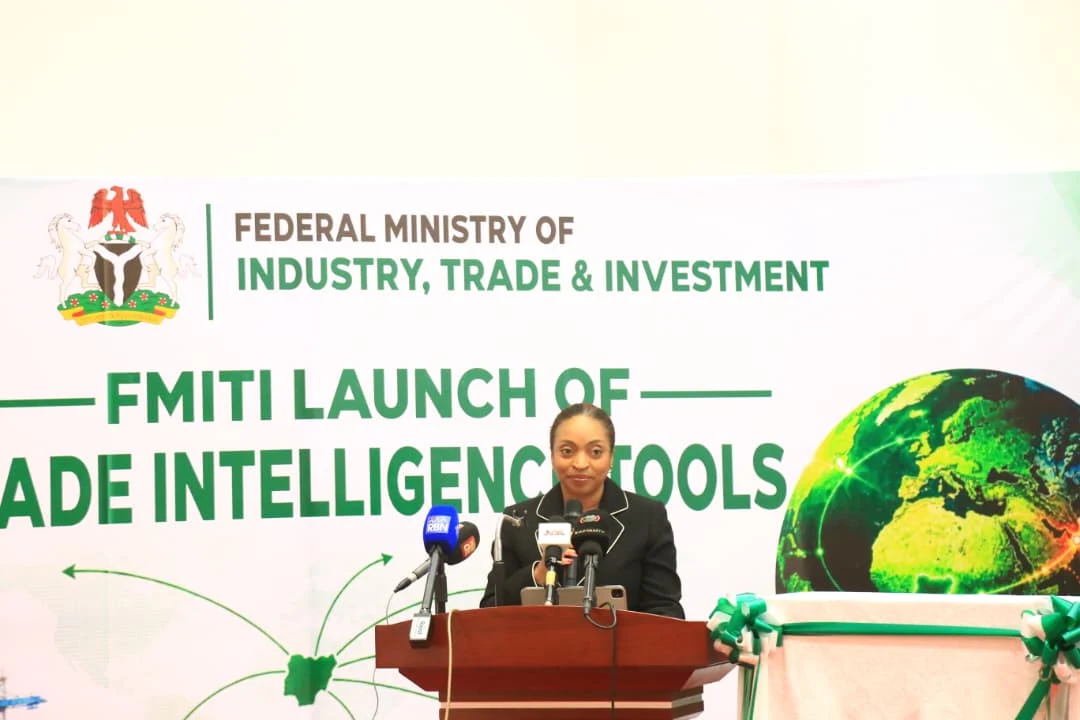
The Federal Government has unveiled its 2026 Trade Intelligence Tools in Abuja, offering Nigerian exporters and smaller businesses a new route to market research on overseas demand, tariffs and trade requirements. The immediate commercial test is whether reliable information can be translated into usable buyer leads and viable export deals.
The Federal Ministry of Industry, Trade and Investment (FMITI) introduced the tools on Thursday, 22 October 2026. At the launch, Minister of Industry, Trade and Investment Jumoke Oduwole said the initiative was designed especially for micro, small and medium-sized enterprises (MSMEs) seeking more informed decisions about international markets. A ministry statement and an independent News Agency of Nigeria report confirm the Abuja event.
What the trade intelligence tools are intended to do
The ministry says the tools are meant to help businesses compare export destinations, examine tariffs and international standards, identify potential buyers and use trade and investment data before committing money to market entry. For an Abuja-based food processor, fashion label, cosmetics manufacturer or business-to-business service provider, that could mean narrowing a long list of possible export countries to a few that merit detailed feasibility checks.
The unveiling also included the 2026 Trade Intelligence Report, which reviews developments during 2025, and a separate assessment covering the first half of 2026. According to the ministry, these reports examine exports, imports, investment flows, agreements and wider market developments. The new outputs follow an earlier edition introduced in November 2025; the ministry also demonstrated a Trade Intelligence Portal at the Abuja event.
That distinction matters. A launch presentation and a portal demonstration do not, by themselves, establish that every planned feature is publicly available, routinely updated or independently verified. The material reviewed for this report does not establish a universally accessible registration link, pricing schedule, guaranteed buyer-matching service or a confirmed number of businesses already using the 2026 platform.
Why this matters to Abuja businesses
Abuja’s commercial economy includes professional services, traders, processors, suppliers and small brands seeking customers outside their immediate market. Export expansion involves expenses before a first shipment: packaging, certification, logistics quotes, product testing, distributor diligence and currency exposure. Poor market intelligence can make those upfront costs more speculative.
More accessible information could help companies choose markets where their products meet demand and avoid pursuing destinations with prohibitive tariffs or costly standards. It could also create work for Abuja-based logistics advisers, export consultants, quality-assurance providers, trade-finance intermediaries and digital-commerce firms. These are potential business effects, however, not confirmed contracts or revenues from the new tools.
Oduwole also identified high production costs, limited finance, logistics constraints and complex trade procedures as obstacles. Market data cannot remove those costs on its own. Its value will depend on information quality, timely updates and connections to practical export-support services.
Export incentives and the next implementation test
The ministry linked the intelligence initiative to broader reforms, including the Export Expansion Grant Scheme, free trade zones and trade-negotiation arrangements. In NAN’s account of the event, the minister referred to work on outstanding Export Expansion Grant claims and a technical working group given 60 days to develop a reform framework. Those remarks describe a reform process rather than a new grant application window or guaranteed payment to any exporter.
NAN also reported plans for a further formal portal launch associated with CANEX Weekend in Lagos on 5–8 November. The ministry’s 22 October account describes the tools as unveiled and the portal as demonstrated in Abuja. Businesses should therefore check the ministry’s latest operating instructions before treating the portal as a fully available transaction service.
Practical steps for MSMEs and exporters
- Start with the product: identify a precise product category and likely destination markets rather than relying on broad export-growth headlines.
- Verify market-access rules: check tariff classifications, documentation, labelling, packaging and standards with the relevant official authorities in the destination market.
- Test the economics: obtain current freight, insurance, certification and financing costs before pricing an overseas order.
- Validate buyers: independently check prospective counterparties, banking instructions and purchase commitments; the unveiling does not amount to a government guarantee of any buyer.
- Track access details: look for the ministry’s official portal link, published user guidance and updates to the trade reports before submitting business or personal data.
For Abuja exporters, the most meaningful evidence of success will be whether the tools make it easier to identify credible demand and reduce avoidable market-entry errors. Useful indicators would include active business users, report-update frequency, verified buyer introductions and completed commercial transactions. No verified performance figures for those outcomes were disclosed in the reviewed launch coverage.
Related Reads
- Canada-Backed TRISEG Targets Export Support for 200 Nigerian SMEs
- TRÏNŪ Opens 700-Container Bonded Warehouse in Kuje, Expands Abuja Cargo Clearance
- Africa–Bangladesh Trade Summit Set for Abuja With 500+ B2B Meetings Planned
Leave a Reply
You must be logged in to post a comment.