
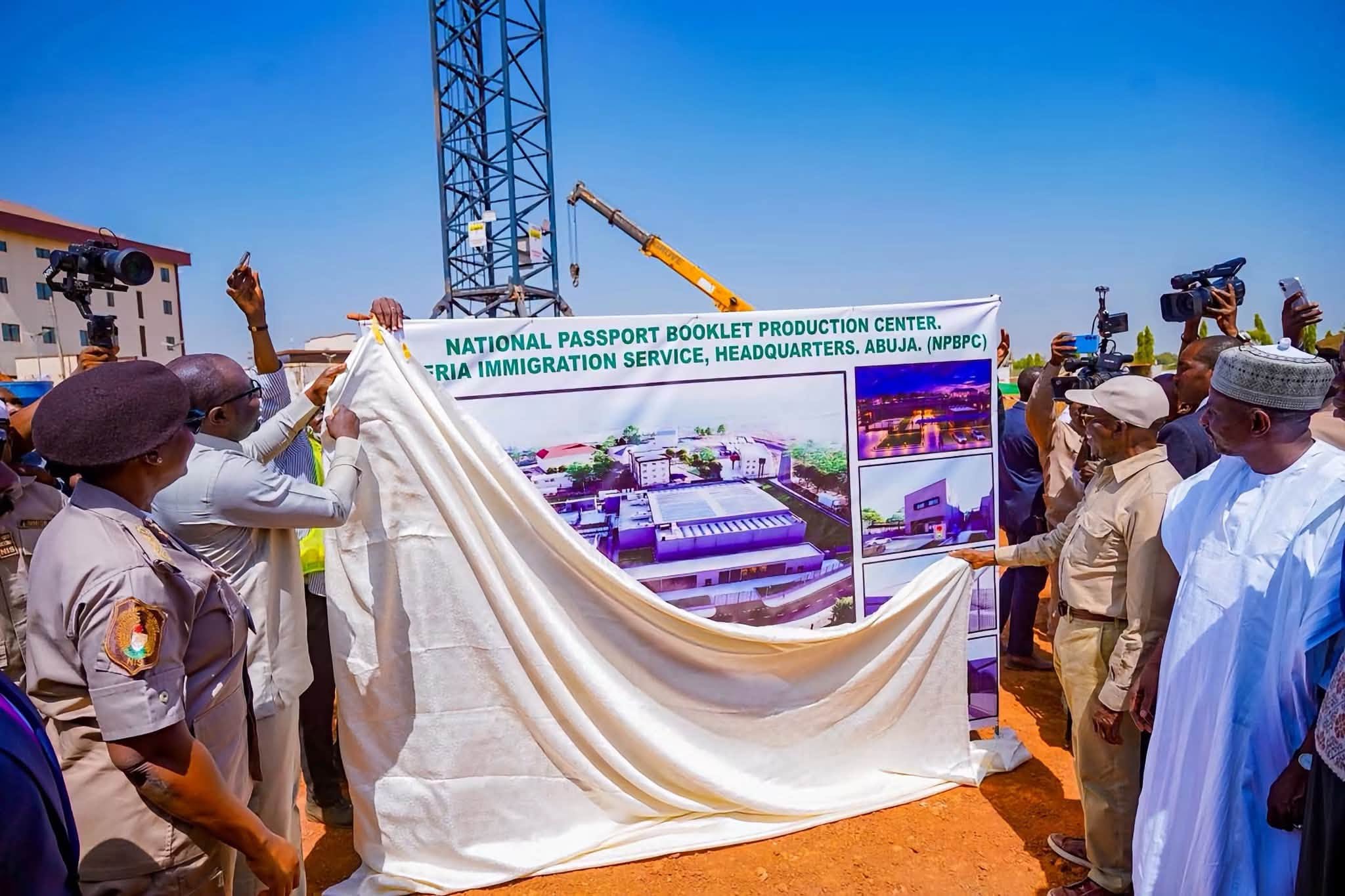
A privately financed US$70 million passport-booklet manufacturing centre has entered construction at the Nigeria Immigration Service headquarters in Sauka, Abuja, with initial annual capacity of six million booklets targeted for May 2027 and scope to scale to 10 million.
The Nigeria Immigration Service confirmed that Interior Minister Olubunmi Tunji-Ojo, Comptroller-General Kemi Nandap and the chairmen of the National Assembly committees on interior led the groundbreaking on 20 November. Independent reports identify IRIS Smart Technologies as the project partner and describe the site as a 1.1-hectare parcel within the NIS headquarters on Airport Road.
The investment has a clear Abuja business angle beyond passport administration. If delivered as announced, it would add a specialised manufacturing operation to the capital, create demand for construction and technical services, localise part of a secure-document supply chain and reduce exposure to imported passport booklets.
What is being built
The planned National Passport Manufacturing Centre is designed to produce the physical e-passport booklets that are later personalised for individual applicants. It is therefore different from the centralised passport personalisation centre commissioned in Abuja in 2025.
Project descriptions published after the groundbreaking say the new plant will be AI-enabled and powered by an off-grid solar system. Its first-phase capacity is expected to reach six million booklets a year, with a later expansion to 10 million.
Those numbers are production targets, not current output. The construction timetable points to commissioning in May 2027, and the government has not published a detailed milestone schedule showing when civil works, equipment installation, testing and security certification must be completed.
The private-capital model
The Interior Ministry and NIS say the approximately US$70 million facility will be entirely privately funded, with no direct financial commitment from the Federal Government. THISDAY reports that IRIS Smart Technologies is committing the capital after an earlier investment in the centralised personalisation centre.
That structure could allow public infrastructure to be delivered without an upfront budget allocation, but the commercial terms matter. The government has not published the financing mix, ownership arrangement, concession period, repayment mechanism, revenue-sharing formula or the obligations attached to the operating agreement.
The Infrastructure Concession Regulatory Commission was represented at the event and said it would monitor compliance with contractual obligations, according to Punch. That provides a regulatory signal, but it is not a substitute for publication of the agreement or a project summary showing how investors recover their capital and how performance will be measured.
Why the capacity matters
The proposed six-million-booklet starting capacity is above the level of domestic demand cited by officials at the ceremony. The spare capacity is intended to improve supply resilience and create room for Nigeria to serve other African markets.
For passport applicants, local manufacturing could reduce the risk that foreign-exchange volatility, overseas production schedules or international logistics disrupt booklet availability. It does not, by itself, guarantee lower passport fees or shorter application queues. Premium Times reported that the minister did not specify how the facility would affect pricing.
Officials also presented the plant as a potential supplier to ECOWAS and wider African markets. That is a commercial ambition rather than a confirmed order book: no export contract, customer country, pricing framework or delivery agreement has been announced.
Business opportunities around the facility
The immediate opportunity sits in project delivery. A secure manufacturing plant of this scale can require civil engineering, specialist mechanical and electrical installation, solar and storage systems, physical and cyber security, clean production environments, testing, maintenance and logistics.
Once operational, the centre could support specialised roles in secure printing, quality assurance, equipment maintenance, software, data protection, supply-chain management and facility operations. The NIS statement also points to employment creation and the development of Nigerian expertise.
However, there is no published hiring plan, supplier-registration notice, local-content target or open procurement package. Businesses should not treat the groundbreaking as an invitation to pay agents for jobs, contracts or vendor slots. Verified opportunities should come through IRIS Smart Technologies, NIS, the Interior Ministry or the appropriate procurement and concession channels.
What remains undisclosed
The announcement leaves several material questions unanswered. There is no public breakdown of the US$70 million capital budget, no list of construction contractors or equipment vendors, and no disclosure of the land or operating rights granted to the private partner.
The parties have also not published environmental approvals, a construction programme, staffing numbers, projected local sourcing, a business-continuity plan or the standards the plant must meet before production begins.
Those omissions do not invalidate the project, but they limit how confidently investors and suppliers can assess its near-term commercial impact. A groundbreaking marks the start of physical delivery; it is not evidence that financing has been fully drawn, equipment has been ordered or production capacity is available.
Practical implications for businesses
- Construction and engineering firms: the project creates a potential pipeline for specialist works, but no open tender or subcontracting notice has been verified.
- Technology providers: AI-enabled production, cybersecurity, quality control and document-security systems may require local support, subject to the prime contractor’s procurement model.
- Solar and facility operators: an off-grid plant implies demand for power generation, storage, monitoring and maintenance over the facility’s operating life.
- Logistics companies: local booklet production could shift part of the inbound supply chain to domestic secure movement and controlled distribution.
- Job seekers: specialised roles may emerge closer to commissioning, but no official recruitment exercise has been announced.
- Passport applicants: stronger booklet supply could reduce one source of delay, but processing time and fees will still depend on wider NIS systems and policy.
What to watch before May 2027
The next credible signals will be visible construction progress, disclosure of the project-delivery structure, appointment of major contractors, equipment installation and a formal testing and commissioning plan.
Commercial observers should also watch for supplier notices, local-content commitments and evidence of export demand. If the plant secures regional customers, the facility could move beyond import substitution into an Abuja-based secure-document export business. Until contracts are disclosed, that upside should remain a scenario rather than a forecast.
The most important test is delivery. Meeting the May 2027 target with secure, certified production would complete the localisation chain described by the government; a delayed or opaque rollout would weaken the claimed investment and supply-chain benefits.
Related Reads
- CBN, NNPC Sign Abuja MoU on FX and Energy Finance
- Bloom Pharmacity Targets 2027 Opening for 30-Hectare Abuja Pharma Park
- FAAN Begins vPASS Biometric Rollout at Abuja Airport
Sources
- Nigeria Immigration Service official statement, 20 November 2026.
- Nairametrics — FG begins construction of $70 million privately funded passport manufacturing centre in Abuja, 21 November 2026.
- Premium Times — Nigeria begins construction of passport factory, targets six million booklets yearly, 20 November 2026.
- THISDAY — Nigeria begins $70m passport factory, targets May 2027 for local production, 20 November 2026.
- TheCable — FG begins construction of $70m centre for local production of passport booklets, 20 November 2026.
Leave a Reply
You must be logged in to post a comment.